
FEDERAL SCHOLARSHIP TAX CREDIT
The Federal Scholarship Tax Credit Tutoring Safe Harbor
and What It Asks of Providers
A scholarship granting organization can pay for individual tutoring and special needs services under the proposed federal scholarship tax credit rules without checking household income, as long as a school in a low-income area chooses which students get them. The trade-off is a yearly audit, and three of its five certifications are about the service.
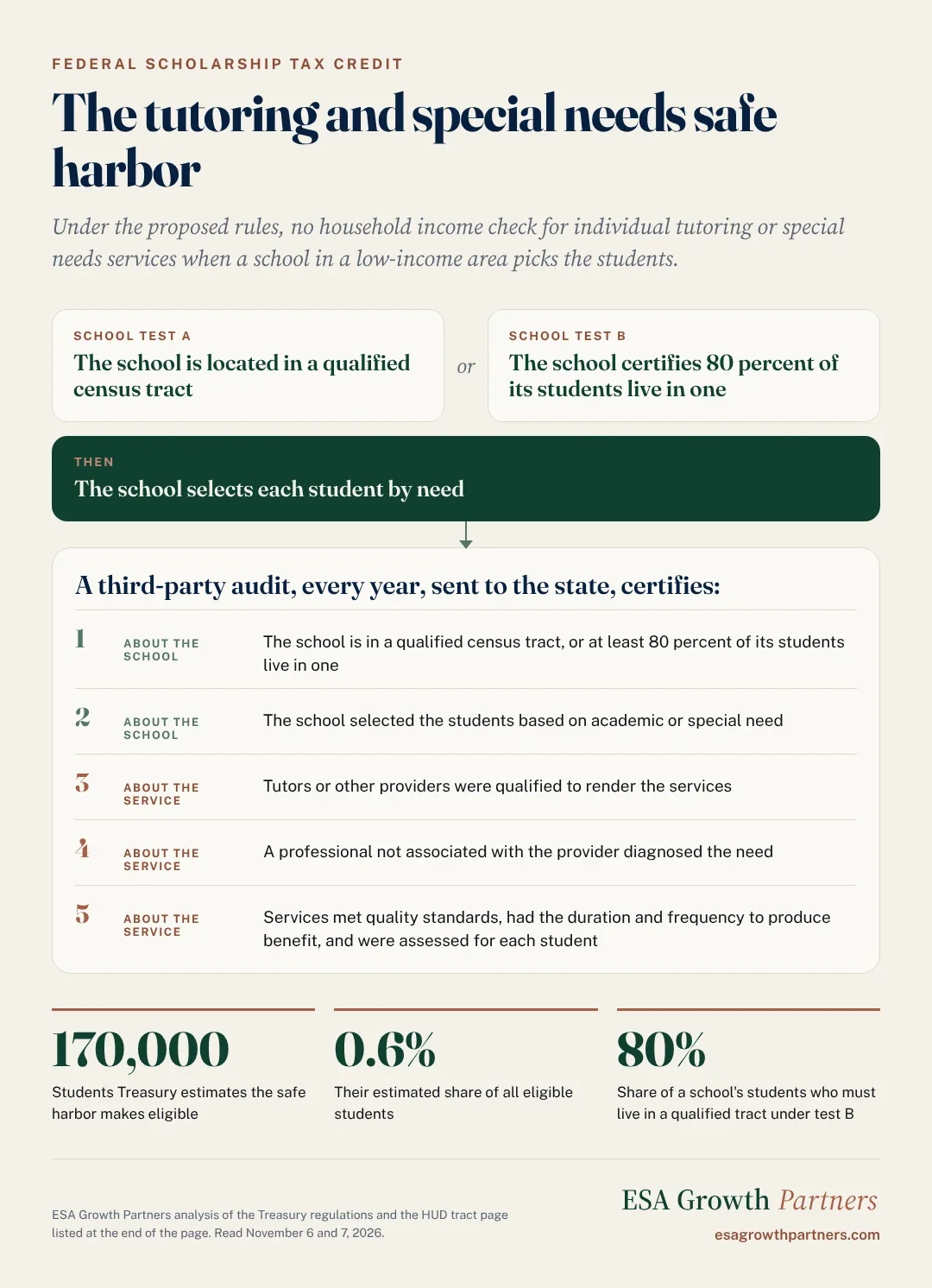
Under the proposed federal scholarship tax credit rules, a scholarship granting organization must verify that each student's household income is no more than 300 percent of area median gross income. However, one safe harbor lets it skip that check for individual academic tutoring and for special needs services, when a school in a low-income area identifies the students who need them. Treasury and the IRS estimate that it would make about 170,000 students eligible who otherwise would not be, 0.6 percent of all eligible students. That counts students who would become eligible. It does not estimate how many scholarships would be awarded.
In return, an organization that uses the safe harbor must obtain a third-party audit every year and give it to the state, and three of the audit's five certifications concern the service itself:
- whether the tutors or other providers were qualified,
- whether a professional not associated with the provider diagnosed the need, and
- whether the services met appropriate quality standards, ran with the duration and frequency commonly required to produce benefit, and were assessed for each student.
Two of those would draw mainly on the provider's records, and the third requires an evaluator outside it. I expect organizations that use the safe harbor to favor tutoring and therapy providers that already keep those records.
Because the school chooses the students, I expect a provider's way into these scholarships to run through the schools it already serves.
What the scholarships may buy is on the Federal Scholarship Tax Credit page.
ESA Growth Partners analysis of the Treasury regulations and the HUD tract page listed at the end of this page (read November 6 and 7, 2026).
What the safe harbor says.
Two ways a school qualifies.
The safe harbor applies only to scholarships for individual students at schools in a low-income area. A school qualifies in one of two ways:
- It is located in a qualified census tract, as identified on the HUD qualified census tract page or in later guidance.
- It certifies that at least 80 percent of its students live in such a tract, wherever the school itself is located.
A qualified census tract is one where enough resident households are low income, or the poverty rate is high enough, under the federal housing tax credit rules. HUD publishes the list. The 2027 tracts take effect January 1, 2027, under a methodology HUD published in the Federal Register on October 6, 2026, while Treasury's estimate of 170,000 students used the 2026 list.
The rules do not say which year's list applies. I would check a school against both the 2026 and 2027 lists and keep a record of both. HUD's page says the 2027 tracts are effective January 1, 2027, but it does not address the scholarship credit, so a school whose status differs between the two lists faces an open question until Treasury answers it. I would check again each year, because a tract's designation can change from one list to the next. A provider can run the same check for each school it works with.
The school picks the students.
The second condition is about who chooses. The students must be "selected by the school on the basis of the particular student's academic or other need." When both conditions are met, the students are treated as satisfying the household income requirement "whether or not the student's household income is verified."
The safe harbor lets a school select on "academic or other need," but the audit certifies that students were selected "based on academic or special need." A school that picks a student for a reason that is neither academic nor a special need could meet the first test and leave the auditor unable to certify the second. Until Treasury lines the two up, I would have schools record each selection as an academic or a special need.
The rules also qualify the usual priority order for these awards. Every organization must give priority to the previous year's recipients and then to students with a sibling the organization funded, but for tutoring or special needs awards the proposed rules say a prior award or a sibling "may not be relevant" and priority "can be based on need for the services."
What the audit certifies.
Five certifications, every year.
An organization using the safe harbor "must annually obtain, and provide to the covered State, a third-party audit" certifying five things. They are quoted here as written:
- "The school meets the eligibility requirement" on location or residence.
- "The scholarship recipients were selected by the school based on academic or special need."
- "Tutors or other providers were qualified to render the services."
- "The student's need for the services, including the nature and extent of the services needed, is independently diagnosed by a professional not associated with the provider or vendor of the services."
- "The services met appropriate quality standards, were provided with a duration and frequency commonly required to produce benefit, and their impact on each individual scholarship recipient was assessed."
The organization also certifies to the IRS each year that it obtained the audit and gave it to the state, and it reports how many students it selected under the safe harbor, state by state for an organization on more than one list. This audit sits beside the general annual audit every organization must have, performed by an outside professional or accredited body. For that general audit, an organization with receipts of $500,000 or less may instead use a committee of independent persons unrelated to its management; the safe harbor does not say that option applies to its own audit.
Three of the five concern the service.
The first two certifications concern the school. The last three concern the service. Two would draw mainly on the provider's own records, and the third needs a professional not associated with the provider.
What each service certification asks for
| Certification | Records that would show it | Left open by the rules |
|---|---|---|
| Qualified to render the services | Credentials, licenses, and training for each tutor or therapist who served the student | What "qualified" means for a tutor or for each kind of special needs service |
| Need independently diagnosed | A diagnosis or evaluation by a professional not associated with the provider, covering the nature and extent of the services needed | Who counts as a professional, and what "not associated" covers |
| Quality, dosage, and impact | Session logs showing duration and frequency, and a measure of each student's progress | Which quality standards apply, and what duration and frequency are "commonly required" |
The "Records that would show it" column is my reading of the evidence an auditor would need; the rules name the certification, not the documents. Keeping these records does not by itself show that the services met the standard; it gives the auditor something to test. A provider's own evaluation will not count as the diagnosis. It has to come from a professional outside the company that delivers the service. An evaluation company that does not serve the student may be able to fill that role, though a shared owner, a payment arrangement, or a referral relationship between the two would need a close look.
Where the safe harbor stops.
Payment works the same way.
The safe harbor only decides whether a student counts as eligible without an income check. It does not change how the money moves. An organization still pays the provider directly only if the provider has been verified as an appropriate provider, is not related to the student, and must repay overpayments, or it pays through a qualified digital wallet or by reimbursing the family with a receipt.
Nor does it change the rest of the organization's rules. With limited exceptions, the student must still live in a state whose list includes the organization, and the organization must still meet every other operating rule.
What the rules leave open.
- Who may perform the safe harbor audit. The safe harbor says "third-party audit" and does not refer to the general audit's rules on who qualifies as an independent auditor.
- How a state should judge a safe harbor audit. Each state must certify that it has procedures for assessing and responding to audit results, but the rules set no standard specific to this audit.
- Which year's qualified census tract list applies.
- What a school must show to certify that 80 percent of its students live in a qualified census tract.
- What "qualified," "appropriate quality standards," and "commonly required to produce benefit" mean for each kind of service, and what counts as a "special needs student" or "special needs services."
Each of these is something a commenter can raise before written comments close on December 1, 2026.
Who it reaches.
Tutoring and special needs services only.
The safe harbor names two services: individual academic tutoring, and special needs services for a special needs student. Tutoring companies are the sellers it reaches directly, and on my reading, so are therapy providers whose service counts as a special needs service for a special needs student. Evaluators may reach it as the independent diagnosing professional, where they do not also serve the student.
The safe harbor does not name curriculum, books, devices, or tuition. A scholarship for those still requires the household income check or another eligibility route, such as categorical eligibility through a needs-based benefit program. For a materials seller, I see this path mattering only where a tutoring or therapy provider it supplies uses its products in the service, a case the rules do not address.
If I ran a tutoring or therapy company that works with schools in low-income areas, I would start now. I would look up each partner school on HUD's 2026 and 2027 lists, keep each tutor's or therapist's credentials on file, log the length and frequency of every session, measure each student's progress the same way each time, and learn which outside evaluators the school uses. I expect an organization choosing providers for these scholarships to want all of it in a form it can hand to its auditor.
Questions about the tutoring and special needs safe harbor
Is the safe harbor in force?
Not yet as a final rule. The safe harbor is in the proposed rules only, and the temporary rules that take effect December 1, 2026, do not include it. The proposed rules say organizations may rely on them for contributions made on or after January 1, 2027, if they follow the proposed rules in their entirety and consistently, until final rules are published.
Does the safe harbor cover group tutoring?
The text names "individual academic tutoring" for "individual students." It does not mention group instruction, and I would not plan on the safe harbor for small-group sessions until Treasury says otherwise.
When can a commenter raise these points?
Written comments on the proposed rules are due December 1, 2026. A public hearing is set for December 15, 2026, by telephone only, and will be canceled if no outline of topics is received by December 1.
Safe harbor scholarships will turn on what a provider can document.
Which organizations in a company's states plan to use the safe harbor, what each will ask a provider to keep, and how a school relationship fits a federal scholarship.
Sources & limitations. Everything above traces to public primary sources, read November 6 and 7, 2026. What is not publicly available is listed.
