
ESA MID-YEAR ENROLLMENT
ESA Mid-Year Enrollment:
Where Winter Money Reaches a Seller
Seven states still let a new family into an ESA for 2026-27. This puts their winter deadlines, prorated awards, and tuition rules on one calendar, read from the seller's side.
ESA mid-year enrollment is still open for 2026-27 in seven states, and most of them cut the award by the date a family comes in. West Virginia's Hope Scholarship pays half of its $5,435.62 award to a family that files by November 30, and a quarter of it from December 1. Iowa pays half of its $8,148 Students First Education Savings Account award through a window that closes November 15, and the family must spend that half on spring tuition and fees before anything else.
Families already in these programs keep receiving deposits through the fall and winter, and that market runs every year. This analysis covers the families who join mid-year. Each one brings less money than a full-year family, and the money lands between December and April. For a company that sells curriculum, tutoring, or other services rather than school seats, the best of those new families are homeschoolers in programs that do not send the money to tuition first: Arizona, Florida's Family Empowerment Scholarship, Unique Abilities, West Virginia, and Texas whenever its waitlist moves.
How a mid-year family gets in.
Three rules decide what a mid-year family brings
A program that takes families after the year starts has to settle three things, and between them they set the size of the market. The first is the door: a fixed window in Iowa, Florida, and Georgia, applications all year in Arizona, West Virginia, and New Hampshire, or a waitlist in Texas and Utah. The second is the cut, either a share fixed by the filing date, as in West Virginia and Texas, or the quarters already paid out, as in Arizona and Florida.
The third is whether tuition comes first: Iowa's statute makes parents pay tuition and fees at the pupil's nonpublic school before any other expense, and Florida's administrator bills private school tuition before a family can reach the rest. So, for a seller, the homeschool families count most. A family that teaches at home brings its whole prorated award to the market. One entering a private school brings whatever is left after spring tuition.
The winter calendar.
The ESA mid-year enrollment calendar runs from November into April
Most of the doors close in November. After that, the dates on the calendar are mostly deposit and payment days. The table lists every program's winter dates in order, and each dollar amount is the program's own published figure.
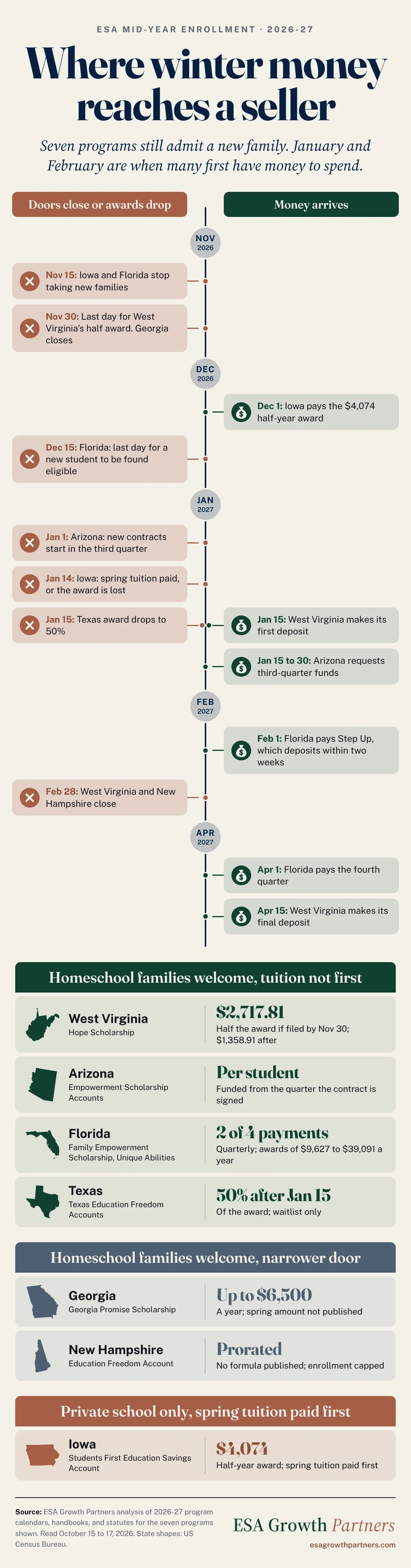
ESA Growth Partners analysis of the program calendars, handbooks, and statutes listed at the end of this page (October 15 to 17, 2026).
Every program’s winter dates, in order
| Date | Program | What happens |
|---|---|---|
| November 1, 2026 | Georgia Promise Scholarship | Student applications open for the spring semester |
| November 15, 2026 | Iowa Students First Education Savings Account | Half-year window closes at 11:59 p.m. |
| November 15, 2026 | Florida Family Empowerment Scholarship (Unique Abilities and Educational Options) and Florida Tax Credit Scholarship | New-student applications close |
| November 30, 2026 | Georgia Promise Scholarship | Spring student applications close |
| November 30, 2026 | West Virginia Hope Scholarship | Last day to file for 50 percent of the award, $2,717.81 |
| December 1, 2026 | Iowa Students First Education Savings Account | Half-year funds available, or 30 days after approval if later |
| December 1, 2026 | West Virginia Hope Scholarship | Award for new filers falls to 25 percent, $1,358.91 |
| December 15, 2026 | Florida Family Empowerment Scholarship, Unique Abilities | Last day for a new student to be found eligible and accept |
| January 1, 2027 | Arizona Empowerment Scholarship Accounts | Third quarter begins; contracts signed from here are funded from the third quarter |
| January 14, 2027 | Iowa Students First Education Savings Account | Half-year students must be attending an accredited nonpublic school and have tuition and fees paid through the portal by 11:59 p.m., or lose the award |
| January 15, 2027 | West Virginia Hope Scholarship | First deposit for filers whose Notice of Intent is in by January 2 |
| January 15, 2027 | Texas Education Freedom Accounts | Confirmations after this date receive 50 percent of the award |
| February 1, 2027 | Florida Family Empowerment Scholarship, Unique Abilities | State pays third-quarter funds to Step Up For Students, which deposits within two weeks |
| February 28, 2027 | West Virginia Hope Scholarship | Last day to apply for 2026-27 |
| February 2027 | New Hampshire Education Freedom Account | Last month to apply for a prorated current-year account |
| April 1, 2027 | Florida Family Empowerment Scholarship, Unique Abilities | State pays fourth-quarter funds to Step Up For Students |
| April 15, 2027 | West Virginia Hope Scholarship | Final deposit, and the only one for filers whose Notice of Intent comes after January 2 |
State by state.
Arizona takes new families all year and publishes what its families spend
The Arizona Department of Education accepts Empowerment Scholarship Accounts applications year-round, and funding begins in the quarter the family signs its contract. A contract signed after January 1 is funded from the third quarter, and a new account takes about three weeks to fund in ClassWallet, the platform the program contracts with. The award is calculated for each student, so Arizona has no single mid-year amount to quote.
A new family in Arizona joins a large base of existing accounts. The Department's report for the fourth quarter of fiscal 2026 counts 99,709 students who received a scholarship. It states that almost 57 percent of families' spending in that April to June quarter went to tuition, textbooks, or fees at a qualified school, an online program, or a postsecondary institution.
Sellers outside a school compete for the rest. By my count from the report's spending tables, about $96.7 million of the quarter's roughly $222.1 million went elsewhere, including $34.1 million on tutoring and teaching services, $19.0 million on supplemental materials, and $15.0 million on curriculum. Under Arizona law, a parent who files no homeschool affidavit may educate at home with the account.
Florida's Unique Abilities program carries the largest awards into spring
Step Up For Students, which administers the Family Empowerment Scholarship, Unique Abilities, takes new applications through November 15, 2026. Florida law caps the program each year, with exceptions for groups such as military and foster families, and a new student must be found eligible and accept by December 15. A student who meets the program's disability eligibility can take part through a home education program with a letter of intent on file with the district, and the family handbook sets no rule that tuition comes first for that student.
The 2026-27 award runs $9,627 to $39,091 depending on matrix level, county, and grade band, and a late start shrinks it. A new student first considered in the third quarter is funded from the state's February 1, 2027 payment to Step Up, which deposits within two weeks. Step Up's schedule leaves only the third and fourth quarters to pay, and Florida law bars a funding organization from submitting a new student after February 1, so that student draws two of the year's four payments.
Florida's private school programs close the same day
The Family Empowerment Scholarship, Educational Options and the Florida Tax Credit Scholarship also close to new students on November 15, require full-time enrollment at an eligible private school, and pay $7,463 to $12,217. Step Up's provider handbook says it commits the full tuition and fees to the school and bills the account for them before a parent can reach any remaining funds, and the same applies to a Unique Abilities student whose family has Step Up bill the school directly. Florida law requires payment of an approved tuition invoice to start within seven business days, and the money can take up to five more business days to arrive.
West Virginia publishes the prorated dollars, and they arrive January 15
Every West Virginia student eligible to enroll in a public school became eligible for the Hope Scholarship on July 1, 2026, because participation stayed under the five percent threshold set in state law. The Hope Scholarship Board takes applications year-round and sets a new student's award by the date the original application is submitted. Through November 30 that is 50 percent of the $5,435.62 award, or $2,717.81, and from December 1 through February 28, 2027 it is 25 percent, or $1,358.91.
The Hope Scholarship FAQ ties each payment to the quarter in which the family files its Notice of Intent. A family that applies by November 30 and files that notice by January 2 receives $1,358.91 on January 15 and $1,358.90 on April 15. A family that applies from December 1 receives $679.45 and $679.46 on the same dates, or the whole $1,358.91 on April 15 if its notice comes later.
A student taught at home or elsewhere takes part through an Individualized Instructional Program and must show academic progress each year, by test or by a certified teacher's review. Families pay providers through the Hope Scholarship portal and buy goods through TheoPay, run by Student First Technologies, which is the program manager.
In Iowa, spring tuition takes the half-year award first
A 2026 law added a second window to Iowa's Students First Education Savings Account, from October 15 to November 15, for the following semester. The payment for a family that enters through it is fifty percent of the regular program state cost per pupil. The Department of Education puts that at $4,074 for 2026-27, available December 1 or 30 days after approval, whichever is later, through Odyssey, the platform the program contracts with, and the student must be attending the school with tuition and fees paid through the portal by January 14, 2027, or lose the award.
Two rules limit who can use it. The student must be enrolled in an accredited nonpublic school, so a homeschooling family cannot enter, and a student homeschooled in 2025-26 qualifies only by enrolling full time. Iowa law then requires parents to pay tuition and fees at the pupil's nonpublic school from the account before any other qualified expense.
An Iowa seller outside the school is paid from whatever $4,074 leaves after spring tuition and fees. The Department publishes no tuition figures, so the size of that remainder is not publicly available. I read Iowa's winter window as a market for the schools themselves, and for other sellers only where spring tuition runs below the half-year award.
Texas prorates by statute, and its winter market waits on the waitlist
Texas law, enacted in 2025, requires the Comptroller to prorate the transfer when a child enrolls in Texas Education Freedom Accounts after the school year begins. The program's funding timelines post of June 4, 2026 sets the steps. A family that confirms enrollment, or opts in as a homeschool or other student, by September 15 keeps the full award; after that it receives 75 percent, and after January 15, 50 percent.
At 75 and 50 percent, that is $7,855.50 and $5,237 on the $10,474 base private school award, and $1,500 and $1,000 on the $2,000 home education award. The June 4 post holds homeschool and other students to the same September 15 deadline for the full award, though no program document states the prorated home education dollars. Once a family is funded, the same law has the certified educational assistance organization pay the provider within 10 business days of verifying a request.
Getting in is the hard part. The last waitlist release the program has published, on August 28, 2026, awarded nearly 4,500 Tier 3 students and counted over 118,000 active awards, more than 109,000 of them funded. The program says it will keep issuing awards from the waitlist until all available funding is allocated. It has published no release since, so a seller cannot put the next group of Texas families on a calendar.
The narrower doors.
Georgia, New Hampshire, and Utah leave narrower openings
The Georgia Promise Scholarship takes student applications from November 1 to 30, 2026, and each application period is for the next semester. A spring applicant must:
- have household income at or below 400 percent of the federal poverty level
- have spent two consecutive semesters in a Georgia public school
- live in the attendance zone of a school on the state's lowest performing list
The award is up to $6,500 a year, paid in four quarterly installments, and the program publishes no amount for a family that enters in spring. A student who leaves public school may be homeschooled with the scholarship, and the family handbook lets the family spend it on curriculum, tutoring by a certified educator, and therapies.
Children's Scholarship Fund New Hampshire, which administers the New Hampshire Education Freedom Account, takes applications through February for a prorated current-year account and publishes no proration formula. The program reached its 12,500-student cap on August 12, 2026. Past the cap, state law keeps enrollment open only to current participants and their siblings, children with disabilities, and families at or below 350 percent of the federal poverty guidelines. A family can teach at home with an account and spend it on curriculum, tutoring, online programs, and technology. State law ends the child's formal home education program when the account starts.
Utah law caps a Utah Fits All Scholarship awarded in the second quarter at 75 percent and in the third at 50 percent, with no new awards in the fourth. Those caps apply only to awards paid from money taken back from students who leave the program, and applications for 2026-27 closed May 1. Odyssey, the program manager, has published no mid-year award since its June notice of a waitlist over 8,800, so I leave Utah off the winter calendar.
Most programs closed their 2026-27 entry before school started
The rest of the field offers a seller few or no new families until next year's windows:
- The Indiana Education Scholarship Account, the LA GATOR Scholarship, the Wyoming Education Savings Account Program, the Tennessee Education Freedom Scholarship, and the Tennessee Individualized Education Account closed their 2026-27 applications before the year began.
- South Carolina's Education Scholarship Trust Fund closed at its 15,000-student statutory limit.
- The Tennessee Education Savings Account pilot closed its second-semester window on October 15.
- Florida's Personalized Education Program admits late applicants only under its deadline exceptions.
- The Arkansas Education Freedom Account approves a late application only when funding is available and the family has moved, taken a foster placement, or relocated for military or state law enforcement service.
Alabama's CHOOSE Act, the Mississippi Education Scholarship Account, MOScholars, North Carolina's Education Student Accounts (ESA+), and Utah's Carson Smith Opportunity Scholarship publish no route for a new family after the year began. That describes what the programs publish. It does not prove that no family can enter.
Where this leaves a seller.
The winter market belongs to sellers whose buyers teach at home
A mid-year family's money reaches a seller without passing through tuition first in Arizona, in Florida's Unique Abilities program for students taught at home, in West Virginia, and in Texas when its waitlist moves. All four admit families who teach at home, and all four pay a new family only for the part of the year that is left. Georgia and New Hampshire also admit families who teach at home, behind narrower doors: Georgia's spring window closes November 30, and New Hampshire has passed its enrollment cap.
The January and February deposits will show how big the new-family market is, because that is when many of these families first have money to spend. West Virginia pays on January 15, Arizona requests third-quarter funds for existing accounts between January 15 and 30, and Florida's state payment reaches Step Up on February 1. Which program is worth a seller's winter depends on what the company sells and where its buyers already are. Sorting that out is the state prioritization work I do in consulting engagements.
Sources & limitations. Everything below traces to public primary sources, read October 15 to 17, 2026. What I could not verify is listed.
