How to Become an Approved TEFA Vendor
The sequence every kind of education company follows to sell through Texas Education Freedom Accounts, from curriculum publishers and hard-goods sellers to tutors, therapists, and schools, with the rule behind each step.
The Texas Comptroller of Public Accounts approves every provider and vendor in Texas Education Freedom Accounts (TEFA), the education savings account program created by Texas Senate Bill 2 (2025). Providers apply through the vendor application on the program's Providers and Vendors page, in a portal run by Odyssey, the program's certified educational assistance organization. Approval rests on the law and the Comptroller's rules: a Texas location or Texas business registration, depending on the category, the qualifications for that category, a background review for anyone who works with children, and certified program commitments.
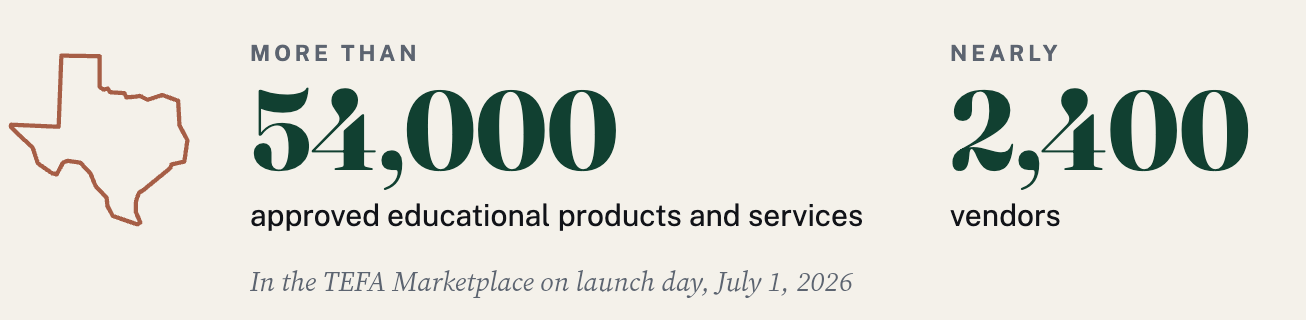
On its launch day, July 1, 2026, the TEFA Marketplace offered more than 54,000 approved educational products and services from nearly 2,400 vendors, according to the Comptroller. Families can spend program money only on approved items bought there, and purchases made outside the marketplace are not reimbursed.
The steps, in order:
Confirm the business can qualify: a Texas location for private schools and pre-K providers, Texas Secretary of State registration for everyone else.
Get current on Texas taxes, including franchise tax where it applies.
Choose the Odyssey vendor category that matches the business.
Gather the category's documents and, for services to children, each lead educator's qualifications.
Submit the application and certify the program commitments under penalty of perjury.
For services to children, complete fingerprinting once the application is approved, pending fingerprints.
Connect a bank account through Stripe, which Odyssey uses to pay every vendor, and list offerings, one at a time or by bulk upload. Each offering is reviewed before it appears.
Fill orders in the vendor portal, and get paid after uploading tracking or a service confirmation.
Who reviews a TEFA vendor application?
The law directs the Comptroller to set the approval process by rule and to accept applications on a rolling basis. Those rules took effect December 15, 2025, and the program's Providers and Vendors page says providers and vendors can apply at any time.
The same page says all vendor applications and offerings are reviewed by the Comptroller to determine eligibility before appearing in the marketplace, so each product or service is reviewed along with the business. Odyssey's vendor requirements name Odyssey as a reviewer alongside the Comptroller. A review time is not publicly available.
The law lets the Comptroller certify up to five educational assistance organizations to help administer the program, and Odyssey is the one selected. The site's FAQ explains what Odyssey and the other program platforms do.
Does a TEFA vendor have to be located in Texas?
That depends on the category. The law lets the Comptroller approve only education service providers located in Texas and vendors registered to do business in Texas. The Comptroller's rules define an education service provider as an approved private school or private prekindergarten or kindergarten provider, and every other approved seller as a vendor.
That makes curriculum publishers, product sellers, online course providers, tutors, therapists, higher education providers, and public schools vendors. When it adopted the rules, the Comptroller revised them "to clarify that a tutor, therapist, or employee of a teaching service is a vendor and does not need to be located in this state." A vendor based elsewhere registers with the Texas Secretary of State instead, which for most out-of-state entities means a foreign entity application for registration and a $750 fee. Odyssey's out-of-state guidance is written for registered entities; its county clerk option for sole proprietorships and general partnerships applies to businesses in Texas.
The rules also require the right to transact business in Texas "by complying with all tax filing, collection, and payment requirements imposed by the state of Texas." Odyssey's vendor requirements also ask every applicant to be in good standing with the Comptroller on Texas franchise taxes, if applicable, which the Comptroller now reports as Franchise Tax Account Status.
Unless the company is a private school or pre-K provider, the vendor classification removes the location test and leaves registration, tax compliance, and, for services to children, staff credentials as the approvals and credentialing work.
Which category does a vendor apply under?
The law names six groups the Comptroller must approve:
- providers the Texas Education Agency approved for supplemental special education services,
- private schools,
- school districts and open-enrollment charter schools,
- private tutors, therapists, and teaching services,
- higher education providers, and
- private prekindergarten and kindergarten providers.
It also lets the Comptroller approve vendors of other approved expenses, which is the route for curriculum, products, technology, online courses, assessments, and transportation.
Odyssey's application sorts these into nine categories. The table maps each kind of business to its category, its location rule, and the section of this post that covers it.
| Business | Odyssey category | Location rule | Covered in |
|---|---|---|---|
| Curriculum and instructional materials | Educational Products | Registered to do business in Texas | Curriculum |
| Technology, supplies, and other hard goods | Educational Products | Registered to do business in Texas | Technology and hard goods |
| Online courses and programs | Not named in Odyssey's guidance | Registered to do business in Texas | Online courses |
| Tutoring and teaching services, including fine arts and physical education instruction | Tutor or Teaching Service | Registered to do business in Texas | Tutors and therapists |
| Therapy | Therapist | Registered to do business in Texas | Tutors and therapists |
| Private schools | Private School | Located in Texas; a virtual school needs a Texas office | Schools |
| Pre-K and kindergarten programs | Pre-K Approved Provider | Located in Texas | Schools |
| Colleges and universities | Higher Education Provider | Registered to do business in Texas | Schools |
| School districts and charter schools | Independent School District/Charter School | Texas public schools | Schools |
| Assessment and transportation services | Not named in Odyssey's guidance | Registered to do business in Texas | Assessments and transportation |
| Anything that fits no other category | Other | Registered to do business in Texas | This section |
Odyssey lists the documents for each category. Nearly every category starts with a Secretary of State record: a Texas Secretary of State certificate of formation, fact, or filing, or, for a sole proprietorship or general partnership in Texas, a county clerk assumed name registration. Educational Products vendors add good standing on Texas franchise taxes, if applicable. Therapists add a professional license, tutors and teaching services a teaching certificate, and pre-K providers a Texas Department of Family and Protective Services license. For each category, an applicant can either upload proof or, where the program can look the credential up itself, authorize it to check.
What can curriculum and instructional materials companies sell?
Odyssey files curriculum publishers under Educational Products. Their listings go into offering categories such as Curriculum, Textbooks, Workbooks, Fiction, Nonfiction, Audiobooks, Educational Material Kits, Online Learning Programs, and Educational Applications.
The sources describe the approved expense in three different ways:
| Source | What it covers |
|---|---|
| The law | Textbooks or other instructional materials "required by a private school, higher education provider, or course in which the child is enrolled," including purchases through a third-party vendor |
| The Comptroller's rules (effective December 15, 2025) | "Textbooks and instructional materials," with no "required by" condition. Instructional materials are "printed or digital materials, supplies, or equipment" that convey educational information or contribute to a student's learning. |
| The Comptroller (August 13, 2026) | Parents can use TEFA for approved expenses "including private school tuition, homeschool curriculum," tutoring, special education services, school supplies, and uniforms |
Odyssey's eligible expenses article, updated July 1, 2026, repeats the law's "required by" wording. Odyssey checks each purchase request against the approved expenses before it pays, and approves a purchase from a provider in good standing when it fits and the child's balance covers it.
Where the sources differ, I'd treat the Comptroller's rules and announcement as the working standard, because the Comptroller runs the program, and write each listing so its educational use is plain. Home-educated students receive $2,000 a year in one installment, so curriculum for that market is priced against a fixed, modest award (see the States page). The third-party vendor language in the law opens a second route: materials a private school or course requires can be bought from an approved curriculum vendor rather than from the school.
What can technology and hard-goods sellers sell?
The rules' definition of instructional materials reaches supplies and equipment. Odyssey's offering categories name the hard goods directly: STEM Kits, Learning Manipulatives, Art Supplies, School Supplies, Printer Supplies, Keyboard, Percussion, String, and Wind Instruments, Instrument Accessories, Sporting Equipment, and Uniforms, alongside a full set of technology categories. Two kinds of goods carry purchase limits:
Laptops, tablets, desktops, monitors, headphones, cameras, webcams, printers, computer accessories, calculators, internet hot spots, and software programs
Together, no more than 10 percent of the student's annual award
3D printers
One purchase per year, inside the same 10 percent
Musical instruments
Price cap of $1,200 per instrument
The 10 percent comes from the law, which also requires technology to be required by an approved provider or vendor or prescribed by a physician. Odyssey's eligible expenses article words the requirement as technology required by the student's enrolled private school or homeschool program. On the 2026-27 amounts on the States page, 10 percent is about $1,047 for a private school student at the base amount and $200 for a home-educated student (my arithmetic). Purchases over a limit may not be approved.
Uniforms have their own guidance: they must be required by the school, and they can be sold as a fully described listing, as fixed-denomination uniform credits, or by the school charging the student's account.
How do product vendors list, sell, and get paid?
Every approved vendor works through Odyssey's vendor portal, but the mechanics matter most for product sellers with large catalogs:
Listing
Each offering goes into one category, with a SKU, description, grade or age range, price, stock quantity, and at least one image. Catalogs can be loaded by CSV bulk upload, with variants. New offerings wait in Pending until reviewed.
Pricing
No more than the standard price charged to everyone else. Shipping is built into the listed price. Odyssey can decline offerings priced out of line with the market.
Checkout
Families buy only in the Odyssey marketplace. A listing can link to the vendor's own site, but the purchase is completed in Odyssey.
Orders
Orders appear in the vendor portal. Products ship within 48 business hours, with tracking uploaded within 72 hours.
Payment
Odyssey pays every vendor by ACH through Stripe, on Net 30 terms starting when tracking or a service receipt is uploaded. The law separately requires payment no later than the 10th business day after Odyssey verifies the purchase request.
Returns
No cancellations after purchase. Returns cover damaged or incorrectly filled orders reported within five business days, and refunds go back to the child's account through Odyssey, never to the family.
Neither the Comptroller nor Odyssey publishes a fee charged to vendors.
What do online course and program providers need?
The law covers tuition and fees for an online educational course or program. An online provider is a vendor, so it registers to do business in Texas rather than locating there, and its listings go into Odyssey's Online Classes or Online Learning Program categories.
Online providers carry one requirement product sellers do not: each person who interacts with a child by reason of their employment, in person or online, needs a complete national criminal history record review dated within 30 days of the application. A virtual private school is different. It applies as a private school and needs a Texas office.
What do tutors, teaching services, and therapists need?
The qualification depends on the role, and everyone who works with a child goes through the same background review. The educator rules cover instruction in electives like fine arts and physical education as well as academic tutoring.
Therapist
A current, relevant license or accreditation from a state, regional, or national certification or accreditation organization
Lead educator at a tutoring or teaching service
One of three: a relevant license or accreditation, current or retired educator at an accredited school, or current or past teaching or tutoring work at a higher education provider
Supporting employee, such as a paraeducator
None of the lead educator's qualifications required
The program's educator credential policy, posted July 7, 2026, requires each student to have a lead educator who carries primary responsibility for instruction and "is continuously present in the physical or virtual learning environment." Odyssey's document list asks tutors and teaching services for a teaching certificate, though the rules and the credential policy also accept the two other qualifications in the table.
The rules call for a complete national criminal history record review dated within 30 days of the application. In the TEFA application, that review is a fingerprint check:
- It starts once an application is approved pending fingerprints, when each listed person receives scheduling instructions.
- It costs $37.
- Results go directly to the Comptroller.
- Fingerprinting done for another program or employer does not count.
Every applicant also documents that each employee who will interact with a participating child has been checked against the state's interagency reportable conduct search engine. If that search engine has not been established, the rules point to the Texas Education Agency's do-not-hire registry instead.
What do schools, pre-K providers, and colleges need?
Private schools
- Accreditation by an organization recognized by the Texas Private School Accreditation Commission or the Texas Education Agency.
- A nationally norm-referenced assessment, or the state assessment, given every year to participating students in grades 3 through 12.
- At least two school years of continuous campus operation before applying.
- A Texas location, or a Texas office for a virtual school. Each campus of a multi-campus school must be operated by the school and covered by qualifying accreditation.
A school may not charge TEFA students more than its standard tuition and fees, though it may keep different standard rates for student categories unrelated to the program. Odyssey's fee guidelines exclude charges such as before- and after-school care, fundraising, and late fees. Private school applications have been open on a rolling basis since December 9, 2025.
Pre-K and kindergarten providers
A provider must be located in Texas and licensed by, and in good standing with, the Texas Department of Family and Protective Services, and must meet one of five further tests:
- accreditation by a research-based, nationally recognized, and universally accessible system approved by the Commissioner of Education,
- Texas Rising Star certification at three stars or higher,
- participation in Texas School Ready!,
- an existing pre-K partnership with a school district, or
- accreditation by an organization recognized by the Texas Private School Accreditation Commission.
Colleges and universities
A higher education provider needs nationally recognized postsecondary accreditation and applies as a vendor. Program money covers its tuition and fees and the textbooks, materials, and uniforms its courses require. Training programs for industry-based credentials approved by the Texas Education Agency are a separate approved expense.
School districts and charter schools
A district or open-enrollment charter school needs Texas Education Agency accreditation. It can sell classes or other educational services only when those services do not count the child toward its average daily attendance.
What do assessment and transportation vendors need?
An assessment vendor must share a child's results with the parent, including the percentile rank where available, and keep the results confidential under state and federal privacy law. A transportation vendor must be a fee-for-service provider carrying children to and from approved providers or vendors, run the same 30-day background review on everyone who interacts with a child, and confirm each driver holds the valid Texas driver's license the service requires.
What does every approved vendor agree to?
Approval requires a certification under penalty of perjury. The vendor agrees to:
- accept program money only for approved education-related expenses,
- charge participants no more than its standard price,
- accept no program money for anything not provided,
- return money received in violation of program rules,
- provide information for program audits, and
- notify the Comptroller no later than the 30th day after it stops meeting the requirements.
Do PDSES-approved providers have to reapply?
No, though they still enroll. The law approves providers that the Texas Education Agency approved for supplemental special education services, now Parent-Directed Special Education Services (PDSES). At the same time, they remain in good standing with the agency. The program page adds Secretary of State registration, and beginning December 9, 2025, Odyssey invited current PDSES vendors to enroll through a streamlined application. Odyssey's fingerprinting article says PDSES pre-approved vendors do not need to provide fingerprinting.
Frequently asked questions
Can an out-of-state company become a TEFA vendor?
Yes. Every vendor other than a private school or pre-K provider can be based outside Texas. It must register with the Texas Secretary of State and comply with Texas tax requirements, and a vendor whose staff work with children must also meet the credential and background review rules.
Is there a deadline for the TEFA vendor application?
No. Applications are accepted on a rolling basis, and providers and vendors can apply at any time.
Can a curriculum company sell through TEFA?
Yes, as an Educational Products vendor. The Comptroller's rules list textbooks and instructional materials as approved expenses, and the Comptroller names homeschool curriculum among approved uses. The law's own wording covers materials that a private school, higher education provider, or course the child is enrolled in requires.
How are TEFA vendors paid?
Odyssey pays every vendor by ACH through Stripe, so each vendor sets up a Stripe account with its banking details. Payment runs on Net 30 terms, starting when the vendor uploads a tracking number or service receipt. The law separately requires payment no later than the 10th business day after Odyssey verifies a purchase request.
How recent must the criminal history review be?
The Comptroller's rules require a review dated within 30 days of the application for each tutor, therapist, or teaching service employee who serves a participating child, and for online course and transportation staff who interact with children.
References
The steps, in order
S.B. No. 2, 89th Legislature, Regular Session, enrolled version, Section 2; Texas Register, adopted rules, 34 TAC §§16.401 to 16.410, 50 TexReg 8046, December 12, 2025; Texas Education Freedom Accounts, Providers and Vendors, undated; Texas Comptroller, "Nearly 73,000 Texas Education Freedom Accounts to Receive Initial Funding July 1", June 30, 2026; Odyssey, "How Do Vendors Get Paid?", updated September 12, 2025; Odyssey, "How To Set Up Your Vendor Stripe Account", updated October 30, 2025. Read October 15 and 16, 2026.
Who reviews a TEFA vendor application?
S.B. No. 2, 89th Legislature, Regular Session, enrolled version, Section 2, Education Code §§29.354 and 29.358(a); Texas Register, adopted rules, 34 TAC §§16.401 to 16.410, 50 TexReg 8046, December 12, 2025, effective December 15, 2025; Texas Education Freedom Accounts, Providers and Vendors, undated; Odyssey, "Who Can Become a Vendor and What are the Requirements?", updated June 30, 2026; Texas Education Freedom Accounts home page, updated September 30, 2026. Read October 15 and 16, 2026.
Does a TEFA vendor have to be located in Texas?
S.B. No. 2, 89th Legislature, Regular Session, enrolled version, Section 2, Education Code §29.358(c); Texas Register, adopted rules, 34 TAC §§16.401 to 16.410, adoption preamble and §§16.401(8), 16.401(26), and 16.404(a), 50 TexReg 8046 to 8073, December 12, 2025; Odyssey, "How Can Out-of-State Vendors or Service Providers Qualify for Texas Education Freedom Accounts (TEFA)?", updated May 11, 2026; Odyssey, "Who Can Become a Vendor and What are the Requirements?", updated June 30, 2026; Texas Secretary of State, Foreign or Out-of-State Entities, undated; Texas Secretary of State, Foreign or Out-of-State Entities FAQs, undated; Texas Comptroller, Franchise Tax Account Status, undated. Read October 15 and 16, 2026.
Which category does a vendor apply under?
S.B. No. 2, 89th Legislature, Regular Session, enrolled version, Section 2, Education Code §29.358(b) and (b-1); Texas Register, adopted rules, 34 TAC §§16.401 to 16.410, §§16.401 and 16.404, 50 TexReg 8069, December 12, 2025; Odyssey, "Who Can Become a Vendor and What are the Requirements?", updated June 30, 2026; Odyssey, "Texas Marketplace: Categories for Offerings", updated March 24, 2026; Texas Education Freedom Accounts, Schools, undated; Texas Education Freedom Accounts, Educator credential policy, July 7, 2026. Read October 15 and 16, 2026.
What can curriculum and instructional materials companies sell?
S.B. No. 2, 89th Legislature, Regular Session, enrolled version, Section 2, Education Code §§29.359(a)(2) and 29.360(c); Texas Register, adopted rules, 34 TAC §§16.401 to 16.410, §§16.401(13), 16.406(3), and 16.407(g), 50 TexReg 8046, December 12, 2025; Texas Comptroller, "Comptroller Don Huffines Announces 100,000 Students Receiving Texas Education Freedom Accounts", August 13, 2026; Odyssey, "What are Eligible Educational Expenses for the Texas Education Freedom Accounts (TEFA) Program?", updated July 1, 2026; Odyssey, "Who Can Become a Vendor and What are the Requirements?", updated June 30, 2026; Odyssey, "Texas Marketplace: Categories for Offerings", updated March 24, 2026. Read October 16, 2026.
What can technology and hard-goods sellers sell?
S.B. No. 2, 89th Legislature, Regular Session, enrolled version, Section 2, Education Code §29.359(a)(8); Texas Register, adopted rules, 34 TAC §§16.401 to 16.410, §§16.401(13) and 16.406(9), 50 TexReg 8046, December 12, 2025; Odyssey, "What Are the Purchase Restrictions for TEFA?", updated October 5, 2026; Odyssey, "What are Eligible Educational Expenses for the Texas Education Freedom Accounts (TEFA) Program?", updated July 1, 2026; Odyssey, "Texas Marketplace: Categories for Offerings", updated March 24, 2026; Texas Education Freedom Accounts, "School Uniforms: Eligible Items and Purchasing Guidelines", July 28, 2026. Read October 16, 2026.
How do product vendors list, sell, and get paid?
S.B. No. 2, 89th Legislature, Regular Session, enrolled version, Section 2, Education Code §29.360(c); Texas Register, adopted rules, 34 TAC §§16.401 to 16.410, §§16.404(a)(4) and 16.407(g) and (h), 50 TexReg 8046, December 12, 2025; Odyssey, "How to Upload Offerings to the Odyssey Marketplace", updated June 12, 2026; Odyssey, "How to Upload Multiple Offerings at Once (Bulk Upload Guide)", updated June 4, 2026; Odyssey, "Marketplace Price Policy", updated July 9, 2025; Odyssey, "Video Tutorial: How to Use the Odyssey Marketplace", updated September 28, 2026; Odyssey, "Vendor Guidelines: Shipping Turnaround Time, Shipping Costs, and Sales Tax", updated February 25, 2026; Odyssey, "How Do Vendors Get Paid?", updated September 12, 2025; Odyssey, "How To Set Up Your Vendor Stripe Account", updated October 30, 2025; Odyssey, "Understanding Refunds, Returns, and Cancellations", updated October 12, 2026. Read October 16, 2026.
What do online course and program providers need?
S.B. No. 2, 89th Legislature, Regular Session, enrolled version, Section 2, Education Code §29.359(a)(1); Texas Register, adopted rules, 34 TAC §§16.401 to 16.410, §16.404(a) and (j)(1), 50 TexReg 8069, December 12, 2025; Odyssey, "Texas Marketplace: Categories for Offerings", updated March 24, 2026; Texas Education Freedom Accounts, Schools, undated. Read October 16, 2026.
What do tutors, teaching services, and therapists need?
S.B. No. 2, 89th Legislature, Regular Session, enrolled version, Section 2, Education Code §29.358(b)(4) and (e); Texas Register, adopted rules, 34 TAC §§16.401 to 16.410, §16.404(a)(4)(F) and (i), 50 TexReg 8069, December 12, 2025; Texas Education Freedom Accounts, Educator credential policy, July 7, 2026; Odyssey, "Who Can Become a Vendor and What are the Requirements?", updated June 30, 2026; Odyssey, "Fingerprinting Requirements for Texas Vendors", updated March 17, 2026. Read October 15 and 16, 2026.
What do schools, pre-K providers, and colleges need?
S.B. No. 2, 89th Legislature, Regular Session, enrolled version, Section 2, Education Code §§29.171, 29.351(4), 29.358(b)(2), (3), and (5), and 29.359(a)(1) to (3); Texas Register, adopted rules, 34 TAC §§16.401 to 16.410, §16.404(b) and (d) to (h), 50 TexReg 8069, December 12, 2025; Texas Education Freedom Accounts, Schools, undated; Odyssey, "Tuition and Fee Guidelines for Participating TEFA Private Schools", updated September 21, 2026. Read October 16, 2026.
What do assessment and transportation vendors need?
S.B. No. 2, 89th Legislature, Regular Session, enrolled version, Section 2, Education Code §§29.357(b) and 29.359(a)(4) and (6); Texas Register, adopted rules, 34 TAC §§16.401 to 16.410, §16.404(j)(2) and (3), 50 TexReg 8069, December 12, 2025. Read October 16, 2026.
What does every approved vendor agree to?
S.B. No. 2, 89th Legislature, Regular Session, enrolled version, Section 2, Education Code §§29.358(g) and 29.363; Texas Register, adopted rules, 34 TAC §§16.401 to 16.410, §16.404(a)(4), 50 TexReg 8069, December 12, 2025. Read October 15 and 16, 2026.
Do PDSES-approved providers have to reapply?
S.B. No. 2, 89th Legislature, Regular Session, enrolled version, Section 2, Education Code §29.358(b)(1); Texas Register, adopted rules, 34 TAC §§16.401 to 16.410, §16.404(c), 50 TexReg 8069, December 12, 2025; Texas Education Freedom Accounts, Providers and Vendors, undated; Odyssey, "Fingerprinting Requirements for Texas Vendors", updated March 17, 2026; Texas Education Agency, Parent-Directed Special Education Services (PDSES), updated June 17, 2026. Read October 15 and 16, 2026.