How to Become an Approved Arizona ESA Vendor
How a curriculum seller, tutoring company, therapist, online program, or private school registers to be paid from Arizona Empowerment Scholarship Accounts, what each vendor category must show, and how ClassWallet pays an approved vendor.
To be paid from Arizona Empowerment Scholarship Accounts, a company registers on a form the Arizona Department of Education links from its ESA pages. Once the Department approves it, the company finishes setting up in ClassWallet, the financial management platform the Department uses for the program, and families can pay it there.
The Department's report for the fourth quarter of 2025-26 counted 99,709 awards. Most of them, 74,509, fell between $7,000 and $8,999, and 11,194 were $30,000 or more. Arizona's program figures and award rules are on the States page.
The Department's own pages and its 2026-27 parent handbook set the rules below. Arizona law requires a new handbook by July 1 of each year. The 2026-27 edition is dated July 1, 2026, and the Department posted it in November 2026; apart from dates, it reads the same as the 2025-26 edition on every rule below.
Who approves an Arizona ESA vendor?
Approval sits with the Department of Education. A company submits the Department's Service Provider Registration form, and the registration and any credentials go to the ESA administrator for review. The Department checks them for completeness, then approves or denies the vendor. Either ClassWallet or the Department can deny a registration or remove a vendor at any time.
The category choice is the company's to make. The Department offers no guidance on which vendor category to pick, and the program keeps no list of recommended schools, vendors, or educational service providers. Arizona law also directs the Department to remove from its payment platforms any tutor or teacher who is subject to disciplinary action by the State Board of Education.
How does Arizona ESA vendor registration work?
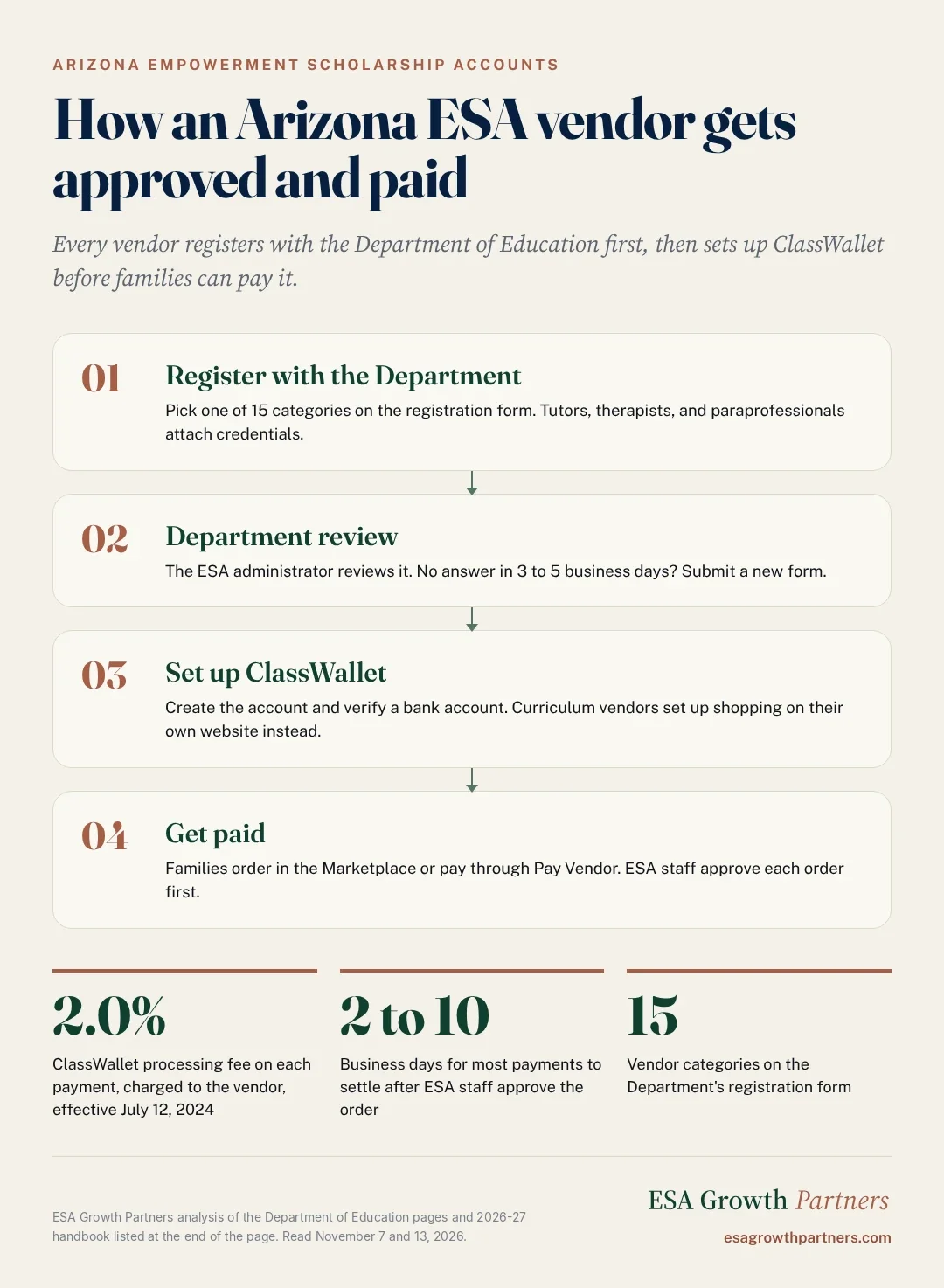
Register with the Department
Complete the Arizona Department of Education Service Provider Registration form and choose the service category. Paraprofessionals, therapists, and tutors must attach proof of certification and its expiration date.
Department review
The ESA administrator reviews the registration and credentials. If 3 to 5 business days pass with no response, the company submits a new registration.
Set up ClassWallet
An approved company receives an email with a link to ClassWallet and its next steps. Every category except curriculum vendors must create a ClassWallet account and verify a bank account to receive ACH payments, and the registration "will NOT be deemed complete" until both are done. Curriculum vendors instead receive a link to work out how families will shop on the vendor's website.
Get paid
Families order through the ClassWallet Marketplace or pay the vendor through Pay Vendor. ESA staff approve each order before ClassWallet releases payment, apart from orders under the Department's auto-fulfillment threshold (see the audit window below).
A private school can use the same registration form, which has categories for in-person and online private schools. It can also register by contacting ClassWallet support at help@classwallet.com. A vendor that changes its business name has to register again.
Which category does an Arizona ESA vendor register under?
The registration form lists fifteen categories, and the category decides which fields the form asks the company to complete. The table gives each category with the form's own description. Five are left blank on the form, so for those the table points to the rules that apply.
Arizona ESA vendor categories on the registration form
| Category | What the form says |
|---|---|
| Curriculum Vendors | Vendors that sell curricula, supplemental materials required or recommended by a curriculum, books, and textbooks |
| Educational Materials and Items | Left blank on the form. Covers supplementary materials and general educational items, explained in the curriculum section below |
| Associated Goods and Assistive Technology | Left blank on the form. Arizona law covers associated goods and services for students with a disability, such as evaluations and assistive technology, explained in the therapists section below |
| Assistive Technology Rental | Rental of low or high assistive technology; a rental agreement must be provided with the invoice |
| In-Person / Online Learning Program | Programs that deliver learning entirely online, such as reading, math, coding, foreign languages, spelling, science, art, and social studies |
| Tutor - Core Subject | Providers with a valid state, national, or regional credential, such as a state teaching certificate or a bachelor's degree or higher |
| Tutor - Specific Subject | Providers with national or regional credentials in their specific area, such as swimming, dance, music, drama, martial arts, or driver's education |
| Therapists | Providers with a therapy license that is not expired, such as speech, occupational, physical, music, vision, and ABA therapy |
| Paraprofessionals | Providers who assist with the educational needs of a child with a disability and hold a Praxis ParaPro, ACT WorkKeys, or ParaEducator credential, with official passing scores |
| Physical Education (organization or facility only) | Left blank on the form, which gives only the name: an organization or facility |
| In-Person Private Schools | Left blank on the form. The school must meet Arizona's qualified school test, explained in the private schools section below |
| Online Private Schools | Private schools that deliver K-12 instruction entirely online |
| Public School | A public school district or public charter school that provides services, classes, programs, or activities |
| Post-Secondary Institution | Left blank on the form. Arizona community colleges, state universities, and accredited private postsecondary institutions qualify |
| Uniform Vendors | Vendors that supply school uniforms, which must be approved by a qualified private school |
What can curriculum and materials sellers sell?
Arizona law lets families spend account money on curricula and supplementary materials. It defines a curriculum as a course of study for content areas or grade levels, including supplemental materials the curriculum requires or recommends, approved by the Department. The State Board defines supplemental material as materials directly related to the course of study that introduce content or support the curriculum.
- A complete curriculum stands on its own and does not need another curriculum to justify it.
- Supplemental materials on the handbook's list need a curriculum that recommends or requires them. Beyond that, the Department approves expenses reasonably related to an educational or vocational purpose, weighing the student's needs, past approvals, the item's primary purpose, and its cost. For curriculum documentation, the family records the student's name, the course of study, learning objectives, the teaching method with lesson plans and a description of activities, and the supplemental material the curriculum requires.
- General education materials are where the documents disagree. For July 1, 2026, to June 30, 2027, the handbook requires no curriculum documentation for supplementary material generally known to be educational, such as art supplies, board games and puzzles, and books, unless law or a court order requires it, and notes that the documentation rule is the subject of a lawsuit pending in Arizona Superior Court. A settlement agreement the Department signed in a Maricopa County Superior Court case over this documentation rule, effective July 1, 2026, goes further, and supplemental materials no longer have to appear on a curriculum document. For items the 2025-26 handbook lists as general educational supplemental materials, the family instead attests that the items support a curriculum or course of study and checks the subjects they support (reading or grammar, social studies, science, mathematics, physical education, art, vocational instruction, or other). The agreement keeps curriculum documentation for other supplemental materials, keeps the Department's power to ask for more information, and phases its platform steps in as the payment platform allows, no later than the second quarter of fiscal year 2027, October through December 2026. As of November 17, 2026, the Department's pages did not say which text governs. Until it does, I would describe each product in a way that ties it to a subject or course of study, which serves a family under either text.
- Computer hardware and devices count when they are primarily educational. Arizona law names calculators, personal computers, laptops, tablets, microscopes, telescopes, and printers, and excludes televisions, telephones, video game consoles, and home theater and audio equipment.
- ClassWallet Marketplace orders ship directly to the address on record once ESA staff approve them.
Curriculum vendors are the one category that does not set up an ACH bank account at registration. The Department instead works with each one on how families will shop its website. Some vendors take orders by email without integrating their websites, and they appear in the ClassWallet Marketplace with a green banner marking them as "Direct Pay" vendors.
What do tutoring companies and teaching services need?
Arizona law allows tutoring or teaching services from an individual who is not subject to State Board disciplinary action for immoral or unprofessional conduct, or from a facility accredited by a state, regional, or national accrediting organization. Allowable subjects run from agriculture, chess, and civics to swimming and woodworking; dog training and any course the Department deems inappropriately explicit are excluded. A class provided by a government entity needs no credential.
A tutor working alone, whether as an individual or a business, documents at least a high school diploma or a higher degree. A business with more than one tutor has two options. The first is an accreditation, worded two ways in the handbook: the business's own accreditation in one place, an approved accreditation or credential for every tutor who serves ESA students in another. The second is the program's tutor and teaching attestation form, certifying that every tutor holds at least a high school diploma from an accredited organization, or, for non-academic subjects, a high school diploma or a certification in the subject taught. Homeschool diplomas are accepted. Full transcripts count as accreditation; screenshots of websites do not.
The registration form describes its Tutor - Core Subject category with a teaching certificate or a bachelor's degree, but for credentials the form itself tells registrants to "review the credential requirements in the ESA Parent Handbook." The table puts the documents side by side.
Tutor credentials in the Department's documents
| Document | What it asks of a tutor |
|---|---|
| Registration form, Tutor - Core Subject | A valid state, national, or regional credential, such as a state teaching certificate or a bachelor's degree or higher |
| Registration form, Tutor - Specific Subject | Specific national or regional credentials in the area taught |
| 2026-27 handbook and ESA Support page, individual tutor | A high school diploma or higher degree from a state, regional, or national accrediting organization |
| 2026-27 handbook and ESA Support page, tutoring business | The business's accreditation, or the attestation form covering every tutor; one handbook passage asks for every tutor's credential instead of the business's accreditation |
What do therapists, paraprofessionals, and evaluators need?
These services are open only to students identified with a disability under the criteria Arizona law sets for them. For those students, Arizona law covers educational therapies from a licensed or accredited practitioner, a licensed or accredited paraprofessional or educational aide, vocational and life skills tuition approved by the Department, and associated goods and services such as educational and psychological evaluations, assistive technology rentals, and braille translation.
- Therapists register with a therapy license that is not expired. Accepted licenses and certifications run from aquatic and art therapy to occupational, physical, music, and recreational therapy. Occupational therapy assistants and physical therapy assistants are approved, and some certifications that are not licenses also count, such as Registered Behavior Technician and American Music Therapy Association credentials.
- An invoice from a therapist or a qualified examiner must carry the provider's license number. A qualified examiner is a licensed physician, psychiatrist, or psychologist.
- Paraprofessionals qualify with one of three tests, the Praxis ParaPro, ACT WorkKeys, or ParaEducator, with official passing scores, or with an associate degree or higher, or 60 or more college credit hours from an accredited school, documented with a degree or full transcripts. One handbook passage adds that paraprofessionals and educational aides "must be licensed."
- Assistive technology rental companies must provide a rental agreement with the invoice.
What do private schools, online schools, and colleges need?
Private K-12 school tuition is an allowable expense only at a qualified school. Arizona law defines one as a nongovernmental primary or secondary school, or a preschool for pupils with disabilities, that is located in Arizona and does not discriminate on the basis of race, color, or national origin. A school just across the border can qualify for students who live on an Indian reservation in Arizona if it is within two miles of the state line. Tuition is allowable only if the school requires all teaching staff and personnel who have unsupervised contact with students to be fingerprinted.
- Private schools register through the registration form or through ClassWallet support. Beyond tuition, a qualified school may charge fees such as application, computer lab, enrollment, facility, registration, supply, transportation, tutoring, and uniform fees.
- Online private schools and nonpublic online learning programs each have their own category, and Arizona law covers tuition or fees for a nonpublic online learning program.
- Public school districts and charter schools can sell individual classes and extracurricular programs.
- Postsecondary institutions qualify if they are an Arizona community college, a state university, or an accredited private postsecondary institution.
- Uniform vendors must be approved by a qualified private school. Uniforms bought from or through a qualified school are covered, and so are uniforms from a vendor the school recommends or requires.
How does ClassWallet pay an Arizona ESA vendor?
Families can spend four ways: the ClassWallet Marketplace, Pay Vendor, a ClassWallet debit card, and reimbursement. A registered vendor is paid through the first two. Under Pay Vendor, the family uploads the vendor's invoice, ESA staff review the order, and ClassWallet releases payment once it is approved. Most transactions settle in the vendor's bank account within 2 to 10 business days of approval, by the Department's own estimate on its ESA Support page.
For a family, paying a registered provider is simpler. Families who pay a registered tutor or provider through Pay Vendor skip the credential upload, because the provider already submitted that documentation and the ESA program reviewed it. A family that pays a provider by debit card or reimbursement must upload a receipt and the provider's credential. Either way, confirming that a provider is properly credentialed remains the account holder's responsibility.
What an Arizona ESA vendor invoice must show
- Name, address, and contact information of the school, program, or provider
- Invoice date and invoice number
- Student name, and grade level for preschool and kindergarten students at qualified schools
- An itemized description of services and charges, including dates of service
- Total charges
- The license number, if the provider is a therapist or qualified examiner
- Fee: ClassWallet payments carry a 2.0% processing fee, lowered from 2.5% effective July 12, 2024, on the entire payment amount, including any fee charged to the parent. The registration form still states the 2.5% rate first, then the change. ClassWallet charges the fee to vendors, and a vendor may charge account holders a processing fee to offset it.
- Audit window: orders processed under the Department's threshold for auto-fulfilled orders are not deemed approved until they are audited or the time to audit them has passed.
- Status: vendors cannot see pending, incomplete, or rejected orders. If an order is not approved within 14 days, the vendor may need to contact the family.
- No rebates: Arizona law bars a school or provider from sharing, refunding, or rebating account money to the parent or student in any manner. A payment received in error goes back to the Department.
Questions about becoming an Arizona ESA vendor
What is an Arizona ESA approved vendor?
It is a company or provider that has registered with the Arizona Department of Education, passed the Department's review, and set up its ClassWallet account, so families can pay it from Arizona Empowerment Scholarship Accounts through the ClassWallet Marketplace or Pay Vendor. The program keeps no list of recommended vendors.
How long does Arizona ESA vendor registration take?
The only timing marker is on the registration form: submit a new form if 3 to 5 business days pass with no response. No other review time is published. After approval, a company other than a curriculum vendor must still create its ClassWallet account and verify its bank account before the registration is complete.
What does ClassWallet charge Arizona ESA vendors, including Marketplace sellers?
Direct Pay vendors in Arizona pay a 2.0% processing fee on the entire payment amount, including any fee charged to the parent, lowered from 2.5% effective July 12, 2024. A vendor may charge account holders a processing fee to offset it. ClassWallet's Marketplace rate is not publicly available.
Is there a list of approved Arizona ESA vendors?
Registered vendors are listed in the ClassWallet Marketplace and in Pay Vendor. The program itself keeps no list of recommended schools, vendors, or educational service providers.
Can a tutoring company register instead of each tutor?
A tutoring business with more than one tutor can register under its business name and document its tutors with an accreditation or the program's tutor and teaching attestation form. The handbook words the accreditation two ways: the business's own, or a credential for every tutor who serves ESA students.
References
Opening
Arizona Department of Education, ClassWallet Information, Become an ESA Vendor / Provider; undated. Read November 7, 2026.
Opening
ESA Growth Partners, ESA Programs by State, Arizona entry, citing the Arizona Department of Education ESA FY26 Quarter 4 Executive and Legislative Report (August 31, 2026). Read November 7, 2026.
Opening
Arizona Department of Education, ESA Parent Handbook and Resources, Current ESA Parent Handbook link; undated. Read November 13, 2026.
Opening
Arizona Revised Statutes, Section 15-2403, subsection K (annual handbook by July 1). Read November 7, 2026.
Who approves an Arizona ESA vendor
Arizona Department of Education Service Provider Registration, introduction and Pre-Registration Step 1 of 2; undated. Read November 7, 2026.
Who approves an Arizona ESA vendor
Arizona Department of Education, Empowerment Scholarship Account Program Parent Handbook, School Year 2026-2027, pp. 13 and 50; July 1, 2026. Read November 13, 2026.
Who approves an Arizona ESA vendor
Arizona Revised Statutes, Section 15-2402, subsection B, paragraph 4, subdivision (d). Read November 7, 2026.
How does Arizona ESA vendor registration work
Arizona Department of Education Service Provider Registration, steps 1 and 2, ClassWallet account and bank verification, curriculum vendors; undated. Read November 7, 2026.
How does Arizona ESA vendor registration work
Arizona Department of Education, ClassWallet Information, Become an ESA Vendor / Provider; Paying a Private School; undated. Read November 7, 2026.
How does Arizona ESA vendor registration work
Arizona Department of Education, Empowerment Scholarship Account Program Parent Handbook, School Year 2026-2027, Vendor registration in ClassWallet, p. 50; July 1, 2026. Read November 13, 2026.
How does Arizona ESA vendor registration work
Arizona Department of Education, ESA Support, Vendors: business name changes; undated. Read November 7, 2026.
Which category does an Arizona ESA vendor register under
Arizona Department of Education Service Provider Registration, Select the service you provide; undated. Read November 7, 2026.
What can curriculum and materials sellers sell
Arizona Revised Statutes, Section 15-2401, paragraph 2 (curriculum). Read November 7, 2026.
What can curriculum and materials sellers sell
Arizona Revised Statutes, Section 15-2402, subsection B, paragraph 4, subdivisions (e) and (p). Read November 7, 2026.
What can curriculum and materials sellers sell
Arizona Department of Education, Empowerment Scholarship Account Program Parent Handbook, School Year 2026-2027, Curricula and supplemental material, pp. 20 to 23; Marketplace, p. 47; July 1, 2026. Read November 13, 2026.
What can curriculum and materials sellers sell
Settlement Agreement and Stipulated Resolution, Aguirre v. State of Arizona, Arizona Department of Education, and Superintendent Horne, Superior Court of Arizona, Maricopa County, sections 1 and 2.1; effective July 1, 2026; copy posted by the Goldwater Institute. Read November 13, 2026.
What can curriculum and materials sellers sell
Arizona Department of Education, ESA Support, curriculum questions; undated. Read November 7, 2026.
What can curriculum and materials sellers sell
Arizona Department of Education, ClassWallet Information, ClassWallet Marketplace and Direct Pay (Pay Vendor); undated. Read November 7, 2026.
What do tutoring companies and teaching services need
Arizona Department of Education, Empowerment Scholarship Account Program Parent Handbook, School Year 2026-2027, tutoring note 7, p. 15; Tutoring or teaching services and the Tutoring / Teaching Services Business Accreditation Attestation Form, pp. 17 to 19; July 1, 2026. Read November 13, 2026.
What do tutoring companies and teaching services need
Arizona Department of Education, ESA Support, Vendors: tutor and teaching service accreditation; undated. Read November 7, 2026.
What do tutoring companies and teaching services need
Arizona Department of Education Service Provider Registration, Tutor - Core Subject and Tutor - Specific Subject; undated. Read November 7, 2026.
What do therapists, paraprofessionals, and evaluators need
Arizona Revised Statutes, Section 15-2402, subsection B, paragraph 4, subdivision (c). Read November 7, 2026.
What do therapists, paraprofessionals, and evaluators need
Arizona Department of Education, Empowerment Scholarship Account Program Parent Handbook, School Year 2026-2027, disability categories and qualified examiner, p. 28; therapy credentials, pp. 30 to 31; paraprofessional or educational aide credentials, pp. 32 to 33; invoice requirements, p. 43; July 1, 2026. Read November 13, 2026.
What do therapists, paraprofessionals, and evaluators need
Arizona Department of Education Service Provider Registration, Therapists, Paraprofessionals, and Assistive Technology Rental; undated. Read November 7, 2026.
What do private schools, online schools, and colleges need
Arizona Revised Statutes, Section 15-2401, paragraphs 4 and 6 (eligible postsecondary institution; qualified school). Read November 7, 2026.
What do private schools, online schools, and colleges need
Arizona Revised Statutes, Section 15-2402, subsection B, paragraph 4, subdivisions (a), (f), (h), (k), and (m). Read November 7, 2026.
What do private schools, online schools, and colleges need
Arizona Department of Education, Empowerment Scholarship Account Program Parent Handbook, School Year 2026-2027, qualified school, p. 15; uniforms, p. 16; Approved qualified school fees, p. 17; July 1, 2026. Read November 13, 2026.
How does ClassWallet pay an Arizona ESA vendor
Arizona Department of Education, Empowerment Scholarship Account Program Parent Handbook, School Year 2026-2027, pp. 13, 17 to 18, 22, 43, 47 to 48, and 50; July 1, 2026. Read November 13, 2026.
How does ClassWallet pay an Arizona ESA vendor
Arizona Department of Education, ESA Support, Vendors: order status, payment timing, payments received in error; undated. Read November 7, 2026.
How does ClassWallet pay an Arizona ESA vendor
Arizona Department of Education Service Provider Registration, Fees; undated. Read November 7, 2026.
How does ClassWallet pay an Arizona ESA vendor
Arizona Revised Statutes, Section 15-2402, subsection J. Read November 7, 2026.
FAQ
Arizona Department of Education Service Provider Registration, introduction and Fees; undated. Read November 7, 2026.
FAQ
Arizona Department of Education, Empowerment Scholarship Account Program Parent Handbook, School Year 2026-2027, pp. 13, 15, 17, 47, and 50; July 1, 2026. Read November 13, 2026.