
ELECTION RESULTS
What the 2026 Election Changes for Companies Selling Into School Choice Programs
The federal tax credit starts on schedule. In four states, the people who write the 2027 budget or run the program changed, or still could, and that is where a provider’s plans need a second look.
For a company paid through school choice programs, the November 3 results matter in four states and in one federal decision. Texas, Arizona, Iowa, and Georgia are where the people who write the 2027 budget or run the program changed, or still could. The federal scholarship tax credit starts January 1 as written, and what moves with these results is which governors file their state’s list of scholarship granting organizations by February 15.
Everywhere else, I expect 2027 to look a lot like 2026. The results do not change a 2026-27 award. The changes come through 2027 sessions and budgets, and most of them take effect with the 2027-28 school year.
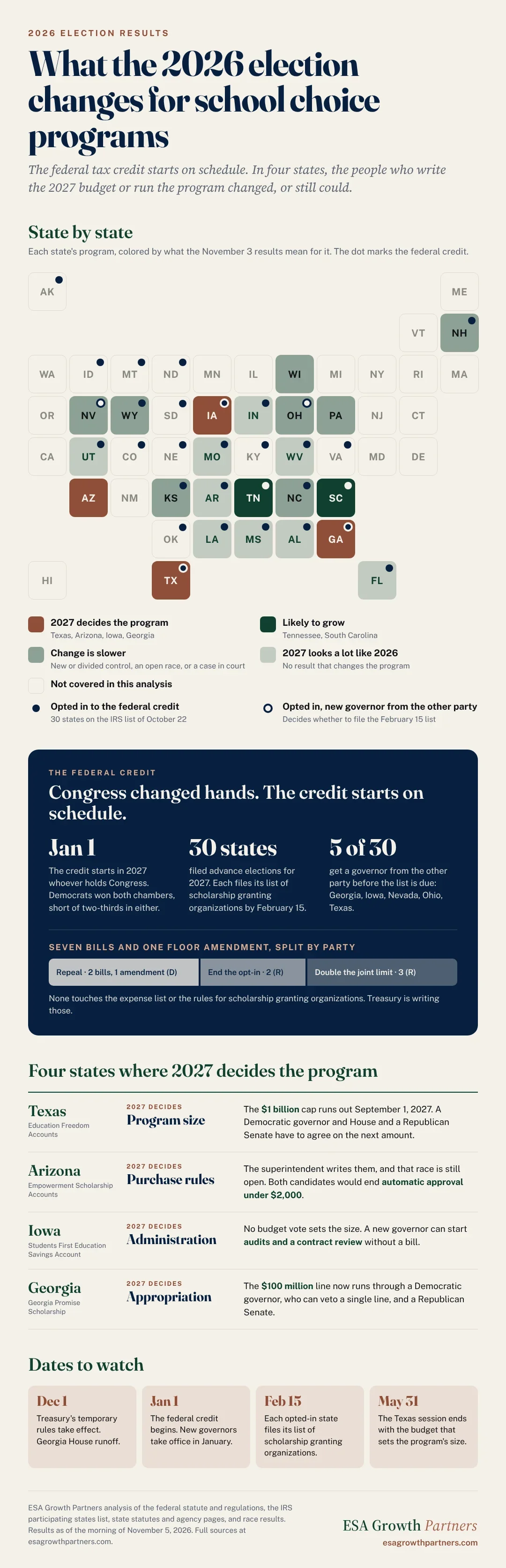
ESA Growth Partners analysis of the federal statute and regulations, the IRS participating states list, state statutes and agency pages, and the race results listed at the end of this page (results as of the morning of November 5, 2026).
The federal credit.
The credit starts on schedule.
Democrats won the House and the Senate, according to AP, and that changes less about the federal credit than it looks. The credit is federal law, created in 2025, and it starts January 1, 2027 whoever holds Congress. Changing it takes a bill through both chambers and the President’s signature, or a two-thirds override.
By my count from AP’s totals on the evening of November 4, Democrats cannot reach two-thirds of either chamber even if they win every race still open. A repeal has no path without the President, and an expansion has none without a Democratic Congress.
What a new Congress could change.
Seven bills and one floor amendment on the credit were filed in this Congress, and they split by party. Democrats filed two bills to repeal it, plus a Senate amendment that was not brought up for a vote. Republicans filed two bills to remove the state opt-in, which would make the credit available in every state, and three that would write a doubled limit for joint returns into the statute.
| Bill | What it would change | Sponsor | Status |
|---|---|---|---|
| Keep Public Funds in Public Schools Act (Senate) | Repeal the credit and the related income exclusion | Sen. Mark Kelly (D-AZ); 35 cosponsors, all Democrats or independents | Referred to Finance |
| Keep Public Funds in Public Schools Act of 2026 (House) | Repeal the credit | Rep. Gwen Moore (D-WI); 107 cosponsors, all Democrats | Referred to Ways and Means |
| Floor amendment to a Senate bill | Repeal the credit and the related income exclusion | Sen. Mazie Hirono (D-HI), with Sens. Van Hollen and Kelly | Filed March 18, 2026; not brought up for a vote |
| Opt-in bill (House) | Remove the state opt-in requirement | Rep. Adrian Smith (R-NE); cosponsors Owens and Walberg | Referred to Ways and Means |
| Opt-in bill (Senate) | Remove the state opt-in requirement | Sen. Bill Cassidy (R-LA) | Referred to Finance |
| Joint filer bill (House) | Write a doubled limit for joint returns into the statute | Rep. Adrian Smith (R-NE); cosponsors Owens and Walberg | Referred to Ways and Means |
| Joint filer bill (Senate) | Write a doubled limit for joint returns into the statute | Sen. Bill Cassidy (R-LA) | Referred to Finance |
| Federal Tax Credit Scholarship Improvement Act | Write a doubled limit for joint returns into the statute; index the $1,700 limit to inflation | Sen. Cindy Hyde-Smith (R-MS) | Referred to Finance |
Treasury’s proposed rules already allow the doubled joint limit, by treating the $1,700 cap as applying to each spouse. Senator Ron Wyden and Representative Richard Neal, the ranking Democrats on the two tax committees, objected to that reading in an October 6 letter, and from January Democrats chair both committees. The rules are still Treasury’s to finalize. Comments are due December 1, the hearing is December 15, and the temporary rules take effect December 1.
None of these bills touches the expense list, which the statute borrows from Coverdell education savings accounts, or the rules for scholarship granting organizations. Those are the rules that decide which provider gets paid and how, and Treasury is writing them.
Senator Cassidy, who sponsored two of the Republican bills, lost his primary and leaves in January. Senator Hyde-Smith, who sponsored the third Senate bill, is in a race still open. I expect the credit to start as written, both sets of bills to be filed again, and neither to pass without votes from the other party.
The governors decide the February 15 list.
The decision these results move sits with the states. Thirty filed advance elections for 2027, on the IRS list of October 22, and each still has to file its list of scholarship granting organizations by February 15, 2027 to complete the election. Treasury’s preamble says a state can, in effect, opt out by not filing it.
Governors’ offices changed party in Georgia, Iowa, Nevada, Ohio, and Texas, and all five are on the IRS list. Each new governor takes office in January, before the list is due, and where the outgoing administration has not filed it, the new one decides whether to. None of the five has said publicly what they will do.
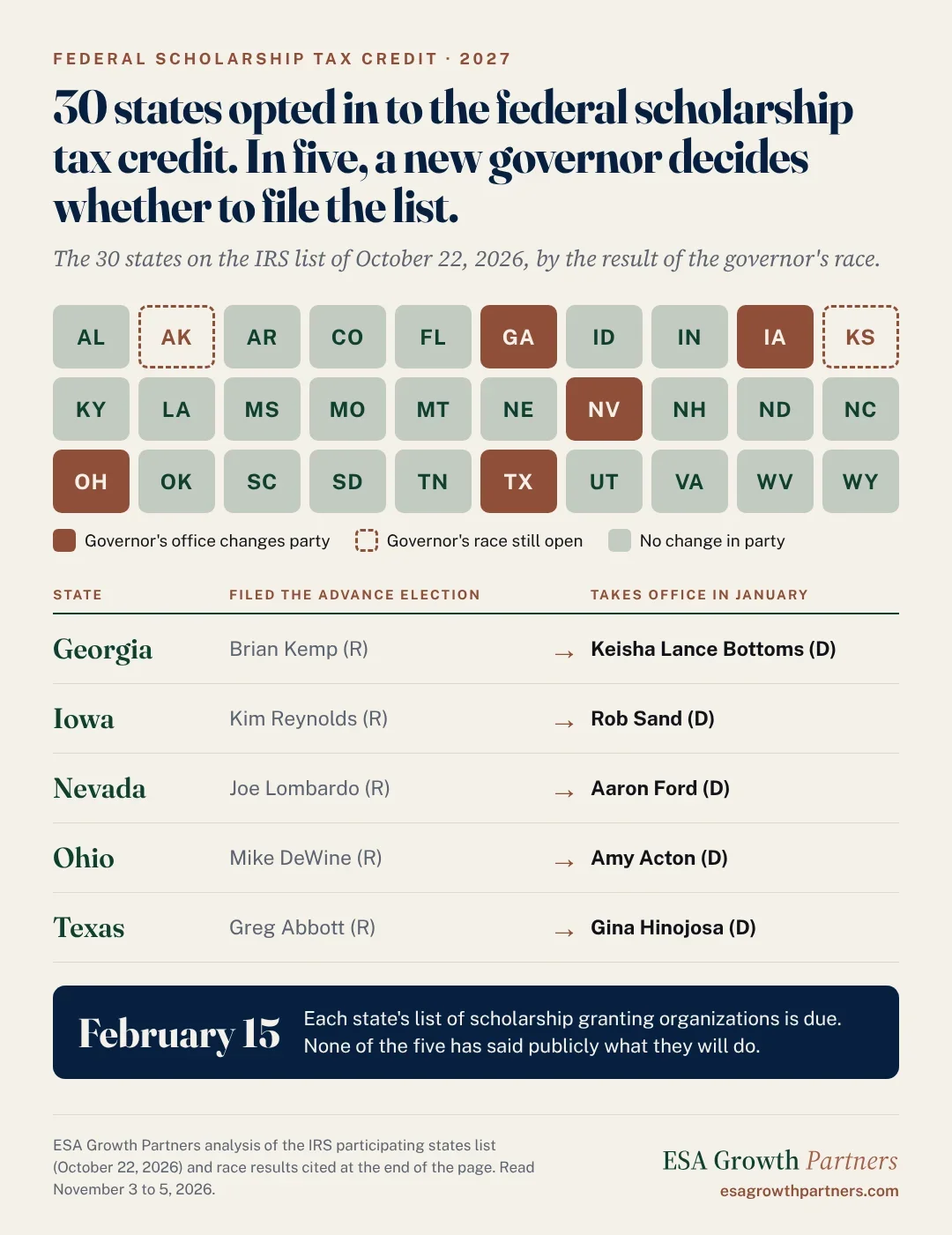
ESA Growth Partners analysis of the IRS participating states list and the race results listed at the end of this page (read November 3 to 5, 2026).
A completed election cannot be revoked, and it still does not lock the list. The temporary rules let a state remove an individual scholarship granting organization at any time during the year, on set grounds and with due process. For a provider working through one organization, that is the exposure in a state where the governor’s office changed hands.
Kansas law requires participation whoever wins, and the governor’s race there is still open. Cindy Holscher (D) voted against overriding the veto of that law, and Ty Masterson (R) voted for it. No Treasury rule says whether a statute like that can be enforced against a governor who declines to act, so that question belongs to state law.
| State | Status for 2027 (IRS list, October 22, 2026) | Governor result | Winner’s own statement on opting in |
|---|---|---|---|
| Georgia | Advance election filed (Gov. Brian Kemp, R) | Keisha Lance Bottoms (D) won; office changes party | No public statement found |
| Iowa | Advance election filed (Gov. Kim Reynolds, R) | Rob Sand (D) won; office changes party | No public statement found |
| Nevada | Advance election filed (Gov. Joe Lombardo, R) | Aaron Ford (D) won; office changes party | No public statement found on the credit |
| Ohio | Advance election filed (Gov. Mike DeWine, R) | Amy Acton (D) won; office changes party | No public statement found on the credit |
| Texas | Advance election filed (Gov. Greg Abbott, R) | Gina Hinojosa (D) won; office changes party | No public statement found on the credit |
| Colorado | Advance election filed for 2027 (Gov. Jared Polis, D) | Phil Weiser (D) won; no change in party | "there’s only one candidate in this race whose position is ’hell no,’ and that’s me." (February 2026 town hall) |
| Alaska | Advance election filed (Gov. Mike Dunleavy, R) | Uncalled; Jonathan Kreiss-Tomkins (D) led with 49.2 percent at about 74 percent counted; ranked-choice results November 18 | No public statement found for any candidate |
| Kansas | Participation required by a statute enacted over Gov. Laura Kelly’s (D) veto | Uncalled; AP showed Cindy Holscher (D) ahead of Ty Masterson (R), 50.3 to 49.7 percent, with 99 percent counted, and a close-race audit is underway | Cindy Holscher (D) voted against overriding the veto; Ty Masterson (R) voted for it |
| Vermont | Not on the list; Vermont law sets conditions for the governor’s list | Phil Scott (R) re-elected | Awaiting Treasury guidance before a final decision: "So at this time, we fully intend to, in an effort to make sure Vermont students can benefit from it." (July 2026) |
| Michigan | Not on the list | Jocelyn Benson (D) won, succeeding Gov. Gretchen Whitmer (D) | "I can’t commit taxpayer dollars to a program under Trump’s control with zero transparency or assurance" (September 2026) |
| Wisconsin | Declined; opt-in bill vetoed, veto sustained | David Crowley (D) won, succeeding Gov. Tony Evers (D) | Spokesperson: "waiting to see the final regulations." |
| Minnesota | Declined (Gov. Tim Walz, DFL) | Amy Klobuchar (DFL) won | No public statement found |
| Maine | No final decision (Gov. Janet Mills, D) | Hannah Pingree (D) won | "I will look hard at that option as Governor." / "If not, we won’t opt in." (June 2026) |
| New Mexico | No final decision | Deb Haaland (D) won | No public statement found |
| California | No final decision | Xavier Becerra (D) won | No public statement found |
In Michigan, Minnesota, Wisconsin, Pennsylvania, Maryland, Massachusetts, and California, the candidates who promised to opt in all lost: John James, Lisa Demuth, Tom Tiffany, Stacy Garrity, Dan Cox, Mike Minogue, and Steve Hilton, all Republicans. Josh Shapiro of Pennsylvania said in October that he has "expressed my openness to this." Tina Kotek of Oregon said she is "open to maybe considering it," Kathy Hochul of New York announced a conditional opt-in on October 9, and Katie Hobbs of Arizona vetoed opt-in bills pending federal guidance.
I expect these results to show up mainly in the 2028 elections, which governors file between January 2 and September 30, 2027. A state electing for the first time after 2027 follows guidance Treasury has not yet issued. For 2027, the five outgoing governors made the advance elections themselves, and the open question in those five states is the February list.
The states.
These entries cover state elections and state policy, and only where the results could change a program a provider is paid through. They run in the order I would look at them.
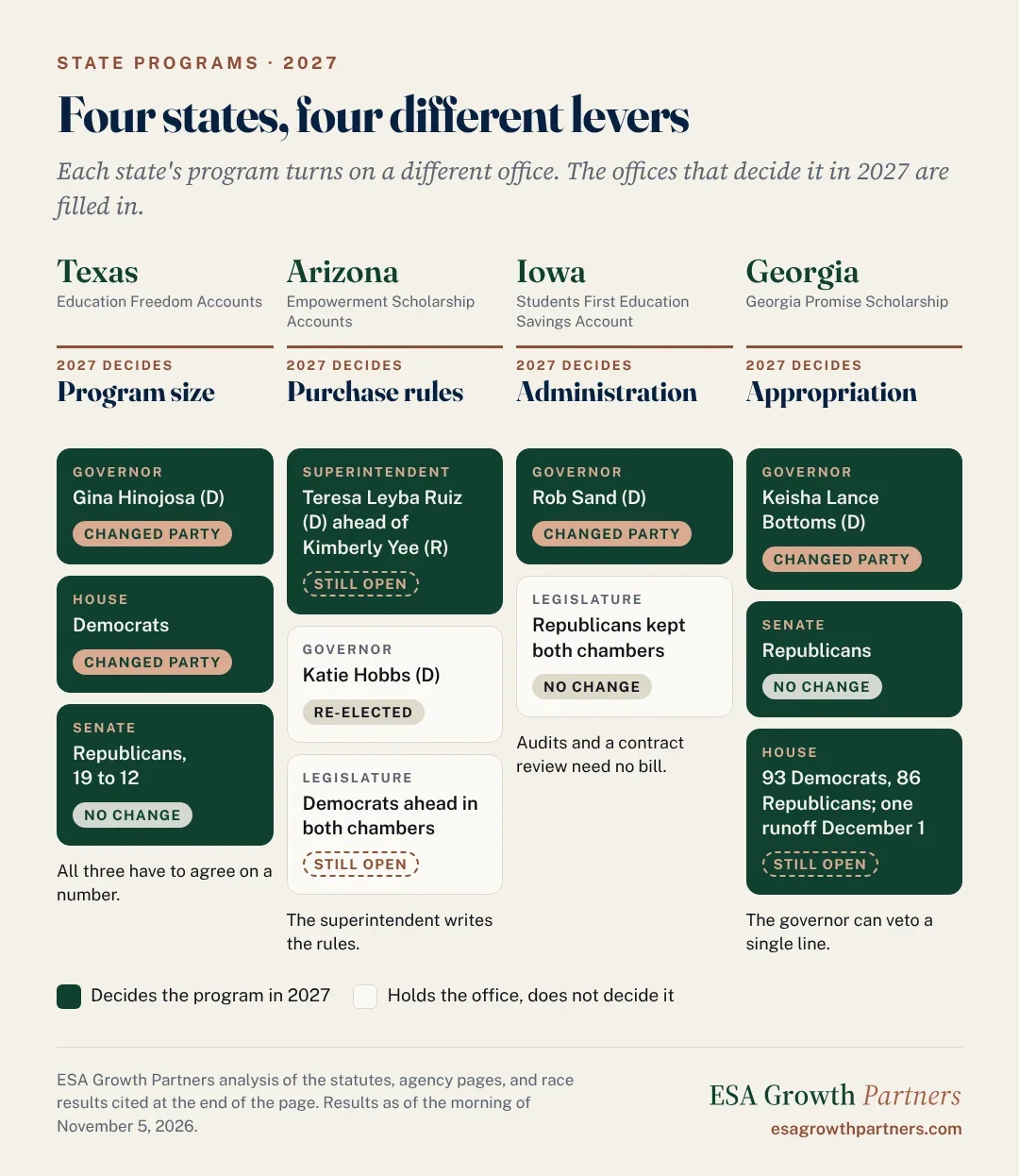
ESA Growth Partners analysis of the statutes, agency pages, and race results listed at the end of this page (results as of the morning of November 5, 2026).
The 2027 Texas budget sets the program’s size.
Texas is where the election changes the planning picture most. The $1 billion cap on the Education Freedom Accounts runs out September 1, 2027, and the statute sets no replacement. The 2027 legislature, in session January 12 to May 31, writes the amount for the next two school years into the budget, and until it does there is no amount for that biennium.
That budget now runs through new hands. Gina Hinojosa (D) won the governor’s race after calling the program "the biggest voucher scam in the whole country." Democrats took the House, Republicans kept the Senate 19 to 12, and Vikki Goodwin (D), who presides over the Senate, won the lieutenant governor’s race. The governor, the House, and the Senate all have to agree on a number.
The 2026-27 awards are $10,474 for a private school student, up to $30,000 for a student with an IEP, and $2,000 for a student in home education, paid in one installment. For a company selling to homeschool families, $2,000 is what the program gives each one to spend, and it lands in a single deposit, so the timing of the 2027-28 deposit matters as much as the amount.
I’d plan 2027-28 Texas revenue at two levels, the current program and a smaller one, and hold fixed Texas commitments until the budget passes at the end of May. Nathan Johnson (D) won the attorney general’s race, and a federal case over which schools may take part, Bayaan Academy v. Hancock, has a motion to dismiss pending and a trial date of July 12, 2027.
Arizona’s purchase rules are likely to tighten either way.
The Arizona Department of Education runs the Empowerment Scholarship Accounts, so the superintendent’s race decides who writes the purchase and approval rules every Arizona provider works under. That race is still open, with Teresa Leyba Ruiz (D) ahead of Kimberly Yee (R), 53 to 47 percent, in an office a Republican held.
Both candidates campaigned on tighter purchase approval. Leyba Ruiz said in a September debate that the program is "written to be exploited." Yee backs real-time controls under which a card for an ineligible item "won’t swipe." Phoenix New Times reported that both would end automatic approval of expenses under $2,000.
Governor Katie Hobbs (D), re-elected, says she will keep "cracking down on waste, fraud, and abuse in the ESA entitlement program." AP has not called either chamber of the legislature, and Democrats led in both on the morning of November 5, according to KTAR. The award is set by the school funding formula, so the amount holds steady while the rules change.
I expect Arizona’s purchase rules to tighten in 2027 whoever wins the superintendent’s race. Smaller purchases feel it first, since automatic approval under $2,000 is what both candidates would end. I’d have every Arizona product listed under the category it belongs to, with its documentation ready, before a new review process starts.
Iowa’s changes come through administration.
Iowa’s Students First Education Savings Account is paid from a standing, unlimited appropriation, so no budget vote sets its size. The award is $8,148 for 2026-27, and the program covers students enrolled in accredited nonpublic schools, so the buyer in Iowa is a private school family.
Rob Sand (D) won the governor’s race. He said in the October 27 debate that "private schools that are taking public money should have to take whichever students" apply, and his plan calls for annual audits and a review of the program’s contract with Odyssey. Changing eligibility or the appropriation takes a bill, and Republicans kept both chambers, according to the Des Moines Register.
An audit and a contract review are steps an administration can start on its own. I expect Iowa’s 2027 changes to show up in what gets reviewed, how payments are made, and possibly on what platform, well before they show up in eligibility or the award. I’d expect more questions about receipts and listings from Iowa in 2027, and I’d have the answers ready.
Georgia’s next appropriation runs through a new governor.
The Georgia Promise Scholarship is an annual appropriation, $100 million for the fiscal year that began July 1, 2026, with awards up to $6,500. Keisha Lance Bottoms (D) won the governor’s race and has made no public statement on the program. Georgia’s governor can veto a single line of an appropriations bill and sign the rest.
Republicans kept the Senate, according to the AJC. AP has not called the House, where Fox 5 Atlanta counts 93 Democrats and 86 Republicans, with one seat going to a December 1 runoff. Lydia Powell (D), the new state school superintendent, said during the campaign that "we’re putting $100 million in vouchers," though the Promise Scholarship is run by the Georgia Education Savings Authority rather than her department.
I expect the Promise line to come out of a negotiation between a Democratic governor and a Republican Senate, close to the current $100 million. Eligibility is narrow, tied to household income and to the attendance zones of the lowest performing schools, so I’d treat Georgia as a targeted market in 2027 rather than one to build volume in.
Where change is slower.
North Carolina’s House changed hands, and the Senate turns on one close district. ESA+ is funded by amounts written into statute, $77.6 million for 2027-28 and $78.6 million for 2028-29, with awards of $9,000 and $17,000. I expect it to hold at those amounts, because changing them now takes agreement among Governor Josh Stein (D), a Democratic House, and whichever party controls the Senate.
New Hampshire re-elected Kelly Ayotte (R), who signed the 2025 law that removed the income test from the Education Freedom Account. WMUR reports Democrats won both chambers, though AP has not called either. Restoring an income test would take her signature or a two-thirds vote, so I expect eligibility to hold through 2027.
Ohio’s EdChoice pays private school tuition, so it matters more to schools than to most providers. Amy Acton (D) won the governor’s race and said she would get "my hands around the out-of-control, not-transparent voucher situation." On October 15 an appeals court held the program unconstitutional "as presently structured, funded, and challenged" and stayed its ruling for an appeal. Payments continue while the stay holds. Keith Faber (R) conceded the attorney general’s race to John Kulewicz (D), though AP has not called it, and Faber said during the campaign that Kulewicz "hasn’t committed" to appealing.
Kansas and Nevada run scholarship tax credits that pay private school tuition. Kansas caps its credit at $10 million a year, and a 2026 bill to raise it to $15 million was vetoed and the veto held. Ty Masterson (R) has said the cap "needs to be expanded," and Cindy Holscher (D) has said, "I oppose diverting taxpayer dollars to private school voucher programs." In Nevada, Aaron Ford (D) succeeds Joe Lombardo (R), who had pledged to raise the Opportunity Scholarship’s funding. Ford has said, "What I do not advocate for and will not support is public money going toward private schools."
Wisconsin and Pennsylvania now have one party in the governor’s office and both chambers. David Crowley (D), Wisconsin’s new governor, said that "trying to do an overnight shutdown of the voucher system doesn’t put our public schools in the best position." Pennsylvania’s two scholarship tax credits are run by its Department of Community and Economic Development, and Josh Shapiro (D) said in his October debate, "It is not an either or." I expect both states to keep current eligibility in 2027, with no expansion.
Where programs are likely to grow.
Tennessee’s Education Freedom Scholarship grew to 35,000 seats for 2026-27, all of them taken, and the Department of Education reported 17,735 applicants on the waitlist when it announced the expansion in May. Marsha Blackburn (R) won the governor’s race saying, "I will fight to expand Education Freedom Scholarships." I expect the 2027 session to raise the cap again, and a waitlist that size to fill new seats as fast as they open.
South Carolina’s Education Scholarship Trust Fund reached its 15,000-student limit for 2026-27, according to the Department of Education, and only the appropriations act can raise it. Alan Wilson (R), the new governor, said in October, "I also strongly support universal school choice," and Ellen Weaver (R), whose department runs the program, was re-elected superintendent. I expect a higher number in the 2027 appropriations act, at an award of $7,634 this year.
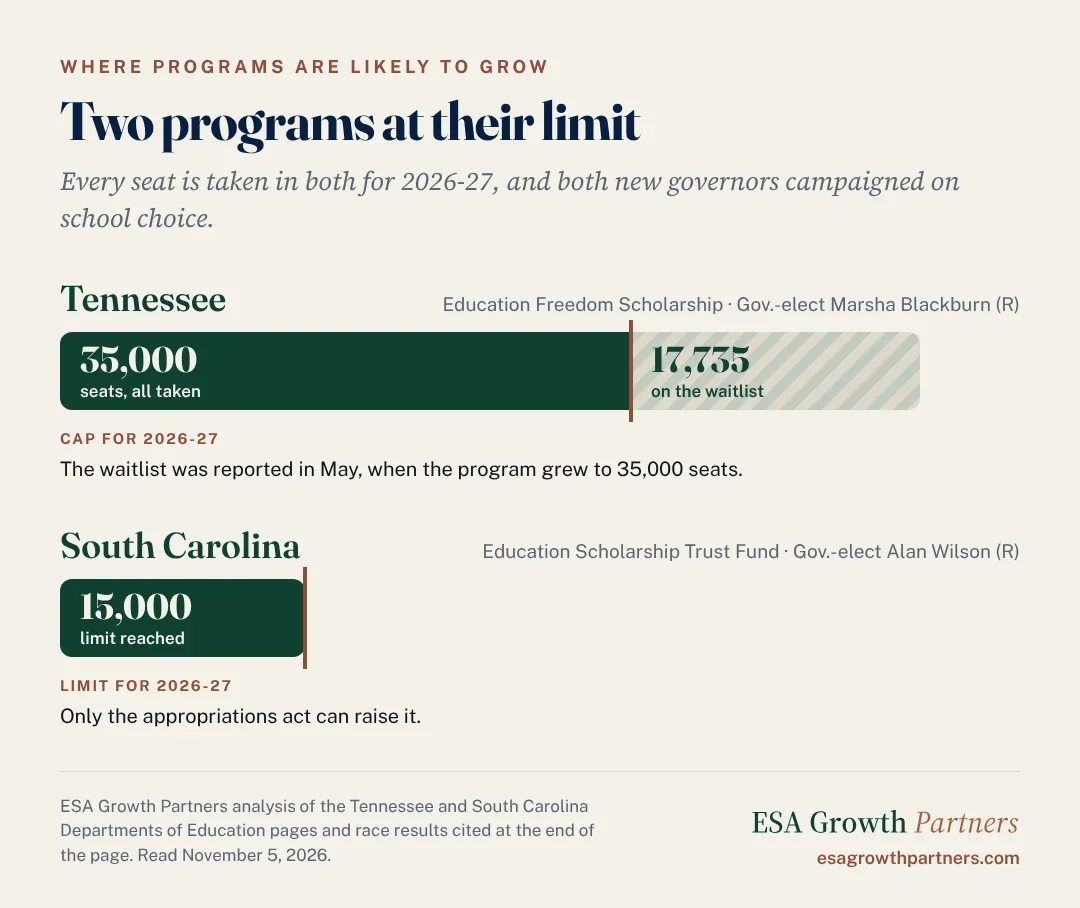
ESA Growth Partners analysis of the Tennessee and South Carolina Departments of Education pages and the race results listed at the end of this page (read November 5, 2026).
Wyoming’s Education Savings Account Program pays $7,000 a year, and its new superintendent, Steve Harshman (R), said during the primary that "we gotta go back and start over," with a focus on "folks who really need it." His department runs the program. The new governor, Eric Barlow (R), sponsored legislation creating accounts for families in hardship, so I expect a narrower program to be on the table in 2027 while litigation over it continues. In Alabama, Tommy Tuberville (R) said participating schools "should be accredited." That bears on schools, and the $2,000 home education award is fixed in statute.
What is still open.
The races still open.
These were uncalled on the morning of November 5, and each one bears on a program or on the federal credit.
| Race | Where it stood | What it decides | Next date |
|---|---|---|---|
| US Senate, Mississippi | Scott Colom (D) ahead of Cindy Hyde-Smith (R) by 1,138 votes, per the Secretary of State | Whether the sponsor of a bill to raise the federal credit returns | Affidavit ballots cured by November 10; counties certify by November 13 |
| US Senate, Alaska | Mary Peltola (D) ahead of Dan Sullivan (R) by 626 votes in the latest state report | One Senate seat; control is already decided | Counts November 10 and 13; ranked-choice tabulation November 18 |
| Governor, Alaska | Jonathan Kreiss-Tomkins (D) at 49.2 percent | Alaska’s 2028 election, and its 2027 list if still open | Ranked-choice tabulation November 18 |
| Governor, Kansas | Cindy Holscher (D) ahead of Ty Masterson (R), 50.3 to 49.7 percent | The tax credit scholarship cap, and how the state’s required participation is carried out | Close-race audit by November 9; county canvasses by November 16 |
| Superintendent, Arizona | Teresa Leyba Ruiz (D) ahead of Kimberly Yee (R), 53 to 47 percent | Who writes the purchase and approval rules for the Empowerment Scholarship Accounts | Count continuing |
| Legislature, Arizona | Democrats ahead in both chambers | Whether changes to the program statute need votes from both parties | Count continuing |
| Senate, North Carolina | Turns on District 24, where Britt (R) leads Hamm (D) by 268 | A Republican majority or a 25 to 25 split | Provisional ballots counted by November 10 |
| House, Georgia | 93 Democrats and 86 Republicans, by Fox 5 Atlanta’s count | Who writes the Promise Scholarship appropriation with the governor and Senate | Runoff December 1 |
| Legislature, New Hampshire | Democrats ahead in both chambers | Whether eligibility changes can reach the governor | Count continuing |
What the results leave open for program money.
Can a new governor take a state out of the federal credit for 2027?
Only where the 2027 election is not yet complete. Treasury does not read the statute as allowing a completed election to be revoked, and its preamble says a state can, in effect, opt out by not filing its list by February 15. Where state law requires participation, as in Kansas, Kentucky, North Carolina, Oklahoma, Idaho, and Tennessee, no federal document settles whether a governor can decline.
Does the election change a 2026-27 award?
No. Each 2026-27 award is set by statute, by formula, or by an appropriation already enacted, and the results amend none of them. Changes come through 2027 sessions and budgets, and most take effect with the 2027-28 school year.
Where does a homeschool seller see the most change?
Texas, where the 2027 budget sets the program behind the $2,000 home education award, and Arizona, where purchase approval is likely to tighten for every account. Alabama’s $2,000 home education award is fixed in statute, and Iowa’s program covers students in accredited nonpublic schools, so the election moves neither one for a homeschool buyer.
WHAT COMES NEXT
Most of the votes are counted. The 2027 budgets come next.
Which of these states is worth the effort in 2027, what each change means for what a company sells, and where the federal credit lands.
Sources & limitations. Everything above traces to public primary sources and named news organizations’ race calls, read November 3 to 5, 2026. What is not publicly available is listed.
